
Where problems start
What faucet end repair covers
Faucet end repair means fixing what happens at the spout tip and the parts that control flow to it: the aerator screen, the cartridge or valve seat inside the handle, and the O-rings and washers between them. It does not mean replacing the faucet. Most end problems are small parts that cost a few dollars.
The signs are easy to read. Water sprays sideways, the stream is thin, the faucet drips after you shut it off, or the handle leaks around its base. Each symptom points to a different part, and the order of repair matters, because fixing the wrong part first just adds a second problem.
For anything beyond the basic fixes, our faucet and sink repair service covers cartridges, valve bodies, and replacements, with a clear price before work starts.
Symptom to part: a quick lookup
Read across to see which part usually fails first.
| Symptom | Usual part | Fix | Skill level |
|---|---|---|---|
| Weak or spraying stream | Aerator screen with scale or grit | Unscrew, soak in vinegar, brush clean | Easy |
| Drip from spout after closing | Cartridge, ball, or seat washer | Replace the cartridge or the seats and springs | Moderate |
| Water around the handle base | O-ring or packing | Replace the O-rings, lubricate with plumber's grease | Moderate |
| Leak under the sink | Supply line or compression nut | Tighten, or replace the supply line | Easy |
| Stiff handle | Scale in the cartridge | Clean or replace the cartridge | Moderate |
| Hot and cold mix when off | Worn check stops or cartridge | Call a plumber | Advanced |
| Water at the faucet body base | Cracked body or loose mount | Call a plumber | Advanced |
Brand matters. Cartridges are rarely interchangeable, so photograph the faucet and bring the old cartridge to the store.
Clearing an aerator in ten minutes
The aerator is the small screen at the spout tip that mixes air into the stream. It collects grit and mineral flakes.
- 1
Remove it
Wrap the spout tip in a cloth to protect the finish and turn the aerator counterclockwise by hand. If it is stuck, use pliers with the cloth in between. Some spouts use a small key, which comes with the faucet.
- 2
Look at what came out
Disassemble the screen, washer, and housing. White crust is scale. Dark grit is sediment from the line. Metal flakes can mean a failing supply line.
- 3
Soak and brush
Put the pieces in white vinegar for an hour, then scrub with an old toothbrush. Rinse. Replace the rubber washer if it is flat or cracked.
- 4
Flush the line, then refit
Before reinstalling, run the faucet for 30 seconds to push debris out of the spout. Then thread the aerator back on and snug it by hand. If flow is still weak, the cartridge or the supply line is next.
Cartridges, spouts, and handles
If the aerator is clean and the faucet still misbehaves, the issue is inside the body.
Cartridge replacement
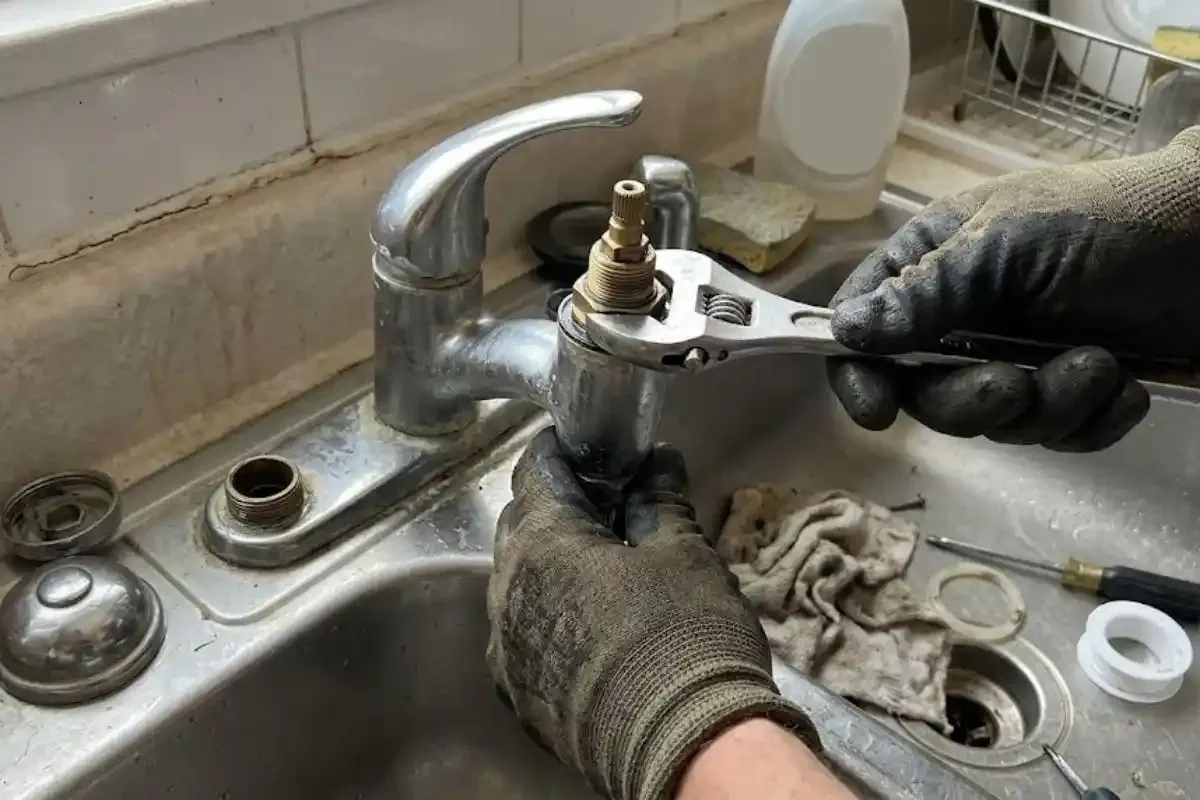
Single-handle faucets use a cartridge that moves up and down and left and right to mix. Close the shutoffs under the sink, remove the handle, pull the retaining clip or nut, and lift out the cartridge. Match it exactly to the new one, then reassemble and test for drips.
Spout end and O-ring leaks
Swivel spouts seal with O-rings at the base. When those harden, water seeps down the side. Replace both rings, coat them lightly with plumber's grease, and keep the spout moving smoothly. A leak that persists after new O-rings usually means a worn body.
Handle drips
Water running down the handle points to a failed packing nut or O-ring under it. Tighten the packing a quarter turn, or replace it. Do not overtighten, because the handle then binds.
Sink versus shower
A kitchen or bath sink faucet has accessible shutoffs under the cabinet. A shower valve usually sits behind the wall with no stop of its own, so you may need to close the main or a fixture stop. If the repair means cutting into the wall, call a plumber.
Faucet still dripping after a new cartridge?
The valve seat or body may be worn. A licensed plumber can check it and quote a clear price before work starts.
Hard water and the faucet end
Mineral scale is the number one cause of clogged aerators and stuck cartridges. The City of Manhattan Beach's 2023 Annual Water Quality Report lists the hardness at two sources, and your tap sees a blend.
Roughly 23 grains per gallon, range 331 to 452
Roughly 8 grains per gallon, range 81 to 220
Scale shows up first at the hot water side and at the aerator, where evaporation leaves mineral behind. In practice, expect to clean aerators often, and expect cartridges to stiffen sooner. Vinegar soaks help, but if you descale often, a water softener or filtration setup cuts the cause for every fixture.
Stop and call a plumber if you see these
Faucet work should stay simple. These signs move the job out of DIY.
- The shutoff will not close.
A seized or leaking stop valve means water keeps running while you work. Do not force it.
- The faucet body is cracked or pitted.
Corrosion at the base or deck means replacement, not repair.
- Hot and cold mix when the faucet is off.
Cross-flow through worn check stops affects the whole line.
- Water stains appear under or beside the cabinet.
A slow leak can soften the cabinet floor. A leak detection visit can trace it.
- Low pressure everywhere.
That points to the supply or the pressure regulator, not the faucet end.
Manhattan Beach note
What the City's water report means for your faucet
The City's 2023 report shows chlorine and chloramine residual averaging 1.8 mg/L, and pH of 7.8 for groundwater and 8.5 for imported surface water. The same report says tap water met all EPA and state primary standards, and that the City cannot control household plumbing materials.
It also advises flushing a tap for 30 seconds to 2 minutes after water sits for several hours. That helps with taste and with old fixtures. If you remove an aerator and find debris, run the tap before refitting, as in the steps above.
Sources: City of Manhattan Beach
Rentals and multifamily
Landlords and property managers know a dripping tap in an empty or busy unit still adds to the water bill. Keep a log of cartridge models per unit so the right part is in the truck. Our crews also work in Hermosa Beach and Lawndale, where the same cartridge and aerator routine applies to rental units.
If water is dripping from the ceiling of the unit below, close the stop and call right away.
FAQs
Faucet end repair questions
Scale or grit in the aerator blocks part of the stream. Unscrew it, soak it in vinegar, and brush it clean.
If the faucet drips from the spout after shutoff, or the handle feels gritty, the cartridge is the most common culprit.
Not usually. Aerators seal with a rubber washer. Tape can block the threads.
The cartridge idea is similar, but the valve sits inside the wall. Closing the right stop and removing trim carefully matter, so many owners call.
Long soaks can dull some finishes, like brushed brass or oil-rubbed bronze. Soak only the removed aerator, not the faucet body.
Yes, it can. The City's 2023 Annual Water Quality Report lists groundwater hardness at an average of 392 mg/L and imported surface water at 136 mg/L. A blend of the two means scale on aerators and cartridges is a regular chore in most homes.