
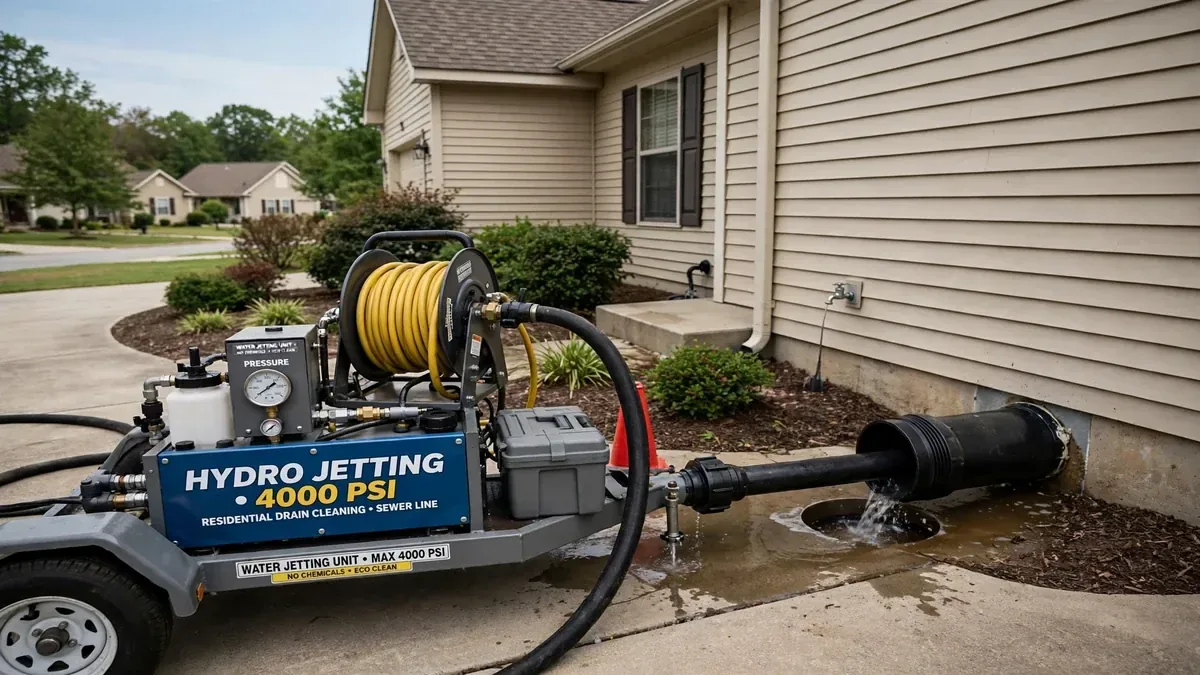
Hydro jetting
What a hydro-jet does that a cable cannot
Hydro jetting is a drain and sewer cleaning method that pushes water through a flexible hose and out of a nozzle at high pressure. The jets point backward to drive the hose forward and sideways to blast the pipe wall. What comes off is grease, scale, silt and root hair, and it flushes down to the City main instead of being dragged back to you.
A truck or trailer-mounted jetter is rated by pressure (psi) and by flow (gallons per minute). Flow does the carrying, pressure does the cutting, and a good setup needs both. Plumbers pick the nozzle, hose length and pressure to match the pipe diameter and what is inside it.
That makes jetting the right call for lines that keep clogging. For a one-off hair clog in a tub, it is overkill.
When a backup is rising after a failed snaking
If sewage or gray water is coming up a floor drain, tub or toilet right now, call. We answer 24/7, and a stuck or ineffective cable is a common reason people phone after hours. Same-day and after-hours visits are how we handle a line that has stopped taking water.
Tell the dispatcher how far the earlier cable reached and what it brought back. A cable that stops at about 60 feet each time suggests a specific spot, such as a root mass, a sag or a joint that has shifted.
While you wait for the plumber
- Stop all water use in the building, including the dishwasher and the washing machine.
- Keep everyone away from the wet area and lift anything on the floor that can be damaged.
- Locate the cleanout cap and note whether water is standing in it, but do not open a cap that is under pressure.
- Do not pour chemical cleaner into the line. It makes the jet crew's job more hazardous.
- Write down what you know: which fixtures failed first, when the last cleaning was and how far the cable ran.
Why does this keep happening?
Why does my drain clog again a few weeks after it was snaked?
Because a cable cuts a channel and leaves the rest. Ordinary drain snaking has that limit. Picture a pipe with a layer of grease and scale on its walls, narrowed from four inches to two. The cable punches a hole through that layer and the water drains. Within weeks, new waste catches on the remaining coating and the hole closes up.
Roots follow the same pattern. A cutter head trims the strands inside the pipe, but the root still reaches back to the joint it entered through, and it regrows with the next wet season. Cleaning the wall back to bare pipe takes away the surface debris clings to.
If that sounds like your line, a jetting pass followed by a camera run is the usual answer. The camera shows whether the pipe is clean, cracked or sagging, so you know if the fix is cleaning or a repair.
Signs a line needs jetting, not just a cable
Any one of these suggests buildup on the pipe wall instead of a single plug.
- Cable stops, backs out and the drain works for a month.
That pattern means the clog is built up along a stretch of pipe, not a single object.
- Slow drains in every bathroom at once.
A main line that has narrowed by half still drains, only badly, and every branch feels it.
- Greasy black water or a thick film on the cable.
Grease and soap residue coat the pipe wall. A cutter head slides through it, while a jet breaks it up.
- Roots on the cable tip.
Fine root hair on a retrieved cable means roots are in the line. Jetting after cutting clears the wall.
- A restaurant or cafe floor drain that backs up weekly.
Fats, oils and starch cling to kitchen drain lines and need periodic scouring.
Jet nozzles and what each one is for
| Nozzle | What it does | Typical use |
|---|---|---|
| Forward-facing penetrator | Drills a small hole through a hard plug | First pass on a fully blocked line |
| Rear-facing spray head | Pulls the hose forward and scours the wall as it returns | Standard cleaning of a sewer lateral |
| Rotating nozzle | Spins to blast a full circle of pipe wall | Heavy scale, grease and silt |
| Root-cutting head | Spinning blade or chain with water assist | Dense root masses before the final jet |
The nozzle is chosen after the camera, not before. A pipe that looks sound on video can take a full-power pass, while a thin or cracked one gets a gentler setup or no jetting at all.
When jetting is the wrong tool
Water at several thousand psi is hard on a failing pipe. We do not jet without looking first, and sometimes the camera says to stop.
Cracked, collapsed or offset pipe
High-pressure water can flush soil into a broken pipe or widen a crack. If the camera shows the line has failed, the answer is a repair, covered on our sewer line repair page.
Old, thin-walled pipe
Deteriorated cast iron and fiber pipe can shed layers under a jet. A gentler cable pass or a jetter on its lowest setting may be safer, and sometimes neither is.
A solid object
A wrench, a child's toy or a chunk of mortar will not wash out. A retrieval cable or a dig is the right tool.
No access point
A jetter needs a cleanout or a pulled toilet to enter. With no entry, the first job is installing a cleanout, not jetting.
A belly full of water
A sagging section holds water no matter how clean the wall is. Jetting clears the debris but the low spot refills, so the sag itself needs correction.
A one-time simple clog
A single hair clog does not need a truck-mounted jetter. A hand auger does the job for less.
Manhattan Beach note
Jetting on hillside and beach-level lots
On the steep Hill Section streets, a lateral drops fast and the jet hose is pulled downhill easily. The practical concern is where the water goes after it passes the clog. A pipe that is partly blocked downstream can back the jet water up into the house, so we confirm the line is open to the City main before long passes.
On flat Sand Section lots the issue is the opposite: a long lateral with little fall that holds debris. Jetting clears it, and the camera finds out whether the low spots are normal or a sign of a sag. Ask us about the grade of your line and we will show it on the camera.
The City asks you to call before flushing or cleaning your lateral. The notice is 24 to 48 hours, because the extra flow from a jet can load the main. The Utilities office is at (310) 802-5304 on weekdays, and the after-hours call center is (310) 802-5000.
Same clog three times this year?
A jet and a camera pass usually settle it for good, or tell you why they cannot.
What drives the cost of hydro jetting
We state a clear price before work starts. Four things set it.
A 20 foot kitchen branch and a 90 foot lateral are different jobs. Bigger pipe takes more flow and more time.
Light scale is quick. Dense roots or years of grease take several passes and sometimes a root-cutting head first.
A clean outdoor cleanout is easy. Pulling a toilet or setting hose through a tight side yard takes longer.
Most jets pair with a pre-jet and post-jet camera run. The video is what proves the pipe is clean and sound.
Insurance often covers sudden, accidental damage but not routine maintenance or buildup. A repeat clog from grease or roots is usually treated as maintenance. Check with your insurer.
Restaurants and multi-unit
Kitchens, cafes and shared building drains
Grease builds fastest where hot water carries fat down a drain and it cools in the pipe. Restaurants and cafes often schedule jetting on a routine instead of waiting for a backup. If your property has a grease interceptor, it needs separate service, and our commercial plumbing team handles the line work around it.
In an apartment or condo building, one shared stack can serve many units. A clog low in the stack backs up into the lowest unit first, so the first call often comes from a ground-floor tenant. A jet pass from the cleanout clears the whole stack at once. We take the same calls from managers in Redondo Beach and the rest of the Beach Cities.
FAQs
Hydro jetting questions we hear from Manhattan Beach property owners
Yes. Our dispatch line runs 24/7, and a sewer or main line backup is treated as urgent. We bring the jetter when the camera and the symptoms say it is the right tool. Same-day appointments are available when the schedule allows for lines that are slow but not yet overflowing.
Often yes, but not always. We run a camera first. Sound pipe takes a standard pass, while thin cast iron, cracked clay or fiber pipe may need a lower setting or a different approach. A camera tells us before we start.
A cable opens a channel through the blockage. A jet scours the whole circumference of the pipe wall and flushes the debris out. Jetting costs more per visit and lasts longer on grease and scale.
It depends on pipe length, the material inside and access. A short branch can finish quickly, and a long lateral with roots needs several passes. The camera run before and after adds time but shows the result.
Water goes down the pipe, not onto the lawn. The risk is a partly blocked downstream section sending water back toward the house, which is why we confirm the line is open to the City main before long passes.
Yes, the City of Manhattan Beach asks you to call before flushing or cleaning your lateral, with 24 to 48 hours notice, because extra flow can block the main and cause an overflow. In an active backup, call the after-hours line and tell them what is happening.