
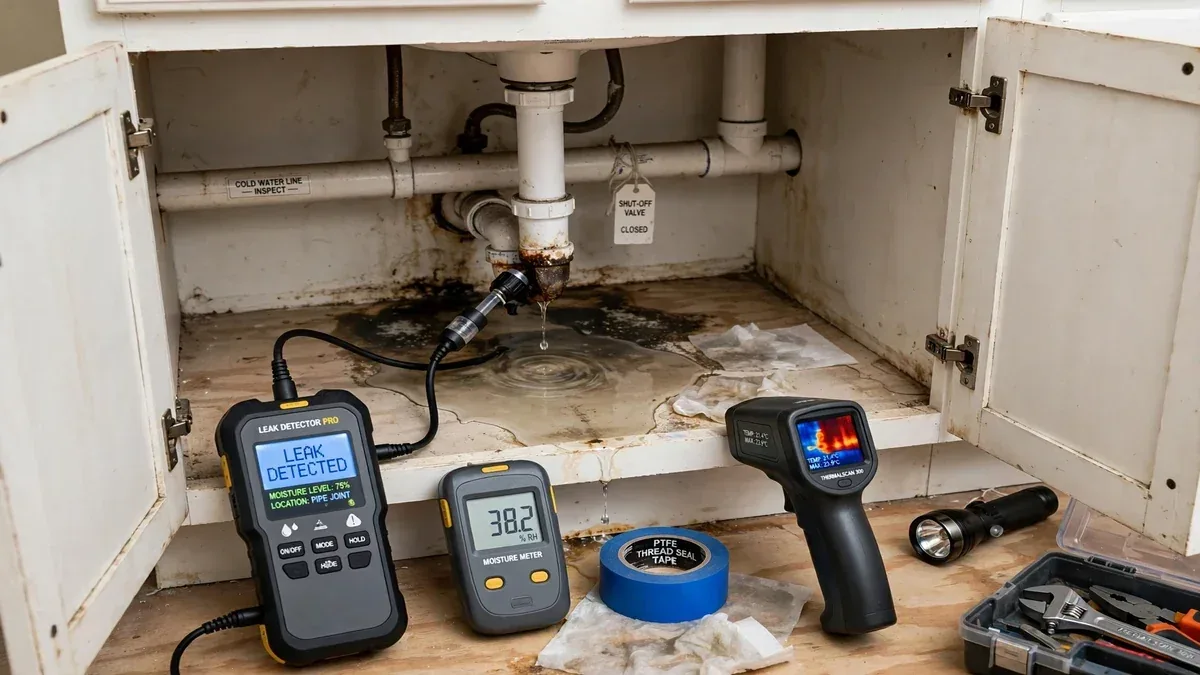
Leak detection
What leak detection actually finds
A leak detection visit answers one question: where is the water going? Supply pipes in a house stay under pressure all day, typically somewhere between 40 and 80 psi, so even a pinhole keeps pushing water out long after anyone has noticed.
Most of those leaks sit behind drywall, under flooring, inside a slab or in the buried line between the meter and the house. Detection uses instruments to narrow that down to a spot you can mark with a pencil, so the repair opens a small patch instead of a whole room.
We run this as an emergency service because a leak you cannot see tends to get worse in the dark. Call the 24/7 dispatch line any hour, and ask about same-day appointments when available.
When a hidden leak cannot wait until Monday
Some leaks are a nuisance and some are an emergency. If you can hear water running behind a wall, see a ceiling stain growing, or find warm or soaking floor near a bathroom, treat it as urgent, because water that stays in framing or insulation starts to damage material within a day or two.
Our dispatch line is open 24/7. Whether the stain showed up on a Friday night or the meter is spinning on a holiday, tell the dispatcher where the water is showing and we will book the earliest visit we can, with same-day appointments when available.
While you wait for the plumber
- Close the main shutoff valve if water is visibly spreading. In many homes it is on the street side of the house near the hose bib, or at the meter box.
- Switch off power to any room with wet ceilings, soaked walls or standing water, and keep outlets in that room unplugged.
- Move rugs, boxes and furniture off wet floors and photograph every damp area with the date visible.
- Write down the meter reading and the time before you close the valve. It helps us confirm the leak is on the supply side.
Start here
Why does my water bill keep climbing?
A bill that rises for two or three cycles in a row, with no new guests, pool or lawn, is one of the most common reasons people call us. Supply leaks are quiet. They do not flood anything. They just add a few gallons an hour that nobody notices until the statement arrives.
The cheapest check costs nothing and takes about twenty minutes. It tells you whether the water is leaking at all, and roughly whether the leak is inside the house or on the line outside. Do it before you pay anyone.
The water meter test, step by step
Your water meter is the one honest witness on the property. When no fixture is using water, it should sit still. Here is how to read it.
- 1
Shut every fixture off
Close all taps, make sure dishwasher and washing machine are idle, pause the ice maker and any irrigation timer, and check that nobody flushes. A softener recharging or a hot tub refilling will fool the test.
- 2
Find the low-flow indicator
Lift the meter box lid. Most meters carry a small triangle, star or dial that spins when even a trickle moves through. Note the position or the last digits on the register, and the time.
- 3
Watch and wait
If the indicator is turning with everything off, water is leaking somewhere downstream of the meter. If it is still, wait fifteen to thirty minutes and read it again. A moved register with no use is a leak, even if the dial looked still at first.
- 4
Split house from yard
Close the main shutoff at the house and check the meter again. If it stops, the leak is inside the house or in the pipe past the valve. If it keeps moving, the leak is between the meter and the shutoff, which means the buried line.
Meters usually read in cubic feet, and one hundred cubic feet equals about 748 gallons, which is why a small billing change can hide a big volume. Toilets are the most frequent false alarm, so drop a few drops of food coloring in each tank and see if color reaches the bowl within fifteen minutes. If it does, the flapper is leaking, a smaller job covered by our toilet repair crews.
Other signs that water is escaping
The meter is only one clue. These are the physical signs that a leak has already started to show itself.
- Sound of running water at night
Hissing or a faint rushing noise in a wall or floor, with all fixtures off, usually means a pressurized line is leaking.
- Warm spots on the floor
A warm patch on tile or hardwood points at a hot water line under the floor. It is also one of the first signs of a slab leak.
- Musty smell or peeling paint
Moisture inside walls grows mold behind baseboards and bubbles paint long before water drips.
- Low pressure at one end of the house
If the shower weakens but the kitchen tap is fine, a leak on that branch may be stealing flow before it reaches the fixture.
- Soft or sunken ground outside
Green patches, soggy soil or a depression along the path from the meter often follow a buried line break.
- Cracks or lifted flooring
Water under laminate or wood makes boards cup and seams open. Grout in a shower or tile floor that keeps going dark can mean a leak below it.
How we find a leak without demolition
No single instrument finds every leak. We pick tools based on pipe material, depth, floor covering and what the meter test told us, and we usually cross-check with a second method before anything is cut.
Acoustic listening
A leaking pipe under pressure makes a hiss that travels through metal pipe and soil. We use an acoustic ground microphone and contact sensors on fittings, then move the pickup in a grid. The loudest spot over the pipe marks the leak. It works best on metal pipe and is weaker on plastic, which damps sound.
Thermal imaging
A thermal camera shows temperature differences on a wall, ceiling or floor surface. A hot water leak under a slab shows as a warm bloom. A moisture meter then confirms whether the area is wet. It will not see through thick material on its own, so it is a clue, not a final answer.
Tracer-gas testing
For stubborn leaks, we drain the suspect line, fill it with a safe mix of about 5 percent hydrogen and 95 percent nitrogen, and sweep the surface with a sensitive sniffer. Hydrogen is the smallest molecule, so it rises through concrete, tile and soil and shows up above the leak. It is slower to set up but excellent for plastic lines.
Pressure testing
We isolate the system with test plugs and watch a gauge. If pressure drops with no flow, there is a leak. Then we isolate branch by branch, hot side against cold side, until the drop stops. This narrows the leak to a section before the other tools pinpoint it.
Which method fits which situation
This table is the framework we use on the first visit. Real jobs often combine two rows.
| Situation | First tool | Backup | Limit |
|---|---|---|---|
| Meter moves, leak somewhere outside | Acoustic ground microphone | Pressure test of the line | Background noise from traffic or irrigation can mask a quiet leak. |
| Warm floor or hot water line suspected | Thermal camera plus moisture meter | Acoustic on the hot branch | Needs a clear temperature difference to show. |
| Plastic or PEX line under concrete | Tracer gas | Pressure test | Longer set-up because the line must be drained first. |
| Wet wall with no obvious source | Moisture meter and thermal | Tracer gas through the wall | A drain or vent leak can look identical to a supply leak. |
| Tenant reports dripping from the unit above | Pressure test of that unit's branch | Acoustic at the shared wall | Needs access to more than one unit. |
| Suspected sewer or drain leak | Drain camera inspection | Dye or smoke test | Not a pressure problem, so supply methods do not apply. |
If the camera points to a cracked drain instead, we move straight to sewer line repair with the same crew.
Meter still moving with everything off?
Give us the reading and what you see, and we will book the visit that finds the leak.
Manhattan Beach homes
Hill lots, beach lots and why leaks travel
Water follows gravity and the path of least resistance. On a steep Hill Section lot, a leaking line can send water downhill under floors and along footings, so the stain you see may be far from the source. That is why we trace from the meter and the shutoff outward, not from the stain inward.
Closer to the ocean, in the Sand Section and El Porto, ground tends to be sandy and drains quickly. A buried leak there can soak away without a wet patch ever reaching the surface, which makes the meter test and acoustic listening more important than visual signs.
The City of Manhattan Beach supplies the water here. For where the meter ends and your responsibility begins on a specific property, ask your water utility before any digging.
Landlords and managers
Leak detection for rentals and multifamily buildings
Rental owners meet leaks differently. The tenant reports a drip or a stain, but the water might originate in the unit above, in a shared riser or in the yard. Chasing the wrong unit costs days and a lot of drywall.
In a duplex or triplex, we shut off one unit's supply at a time and watch the meter, which separates the building into sections quickly. Where the building has a master meter and individual units, we test each branch with pressure gauges. Units with a shared wall are checked with acoustic sensors on both sides.
What property managers and owners should have ready
Meter access and shutoffs
Know where each unit's isolation valve and the building's main are, and keep lockbox or gate access current so a late-night call does not stall.
Tenant notice
Give tenants notice of a visit and ask them to leave sinks and showers off. Moisture photos from the tenant speed up the first call.
Records
Past bills, prior leak repairs and any earlier moisture reports help us connect old problems to the new one and sort the owner's repair from a tenant fixture issue.
Commercial buildings, restaurants and offices have their own risks, and our team handles those through commercial plumbing when the property is not residential.
After the leak is found
Finding the leak is half of the job. We mark the location on the surface, explain what we found and what the repair will involve, and give you a clear price before work starts. You are not obligated to let us do the repair, though many owners do because the crew already knows where to open.
Typical repairs are a spot fix on a corroded section, a replaced fitting, or a reroute around the damaged length. When the problem is deep under a floor, we go through your options on slab leak repair, and when the line under the yard has failed we cover water line repair. If pipes are failing in several places, ask about repiping.
Permit rules differ by job. Ask the Manhattan Beach Community Development department what applies before work begins on pipe replacement.
What drives the cost of leak detection
Pricing is not a flat number because no two leaks are the same. These are the factors that decide what you pay.
A leak found by the meter test and one acoustic sweep takes less time than one that needs tracer gas and a second pass.
Metal pipe carries sound well. Plastic and deep burial need more equipment and time.
Furnished rooms, locked units and tight crawlspaces slow the survey.
A single bathroom is a short job. A fourplex or a whole building takes systematic testing floor by floor.
Detection is one line item. Opening a wall, replacing pipe and restoring the surface are separate and itemized.
Insurance often covers sudden damage from a burst or accidental discharge, but may not cover a slow leak or ordinary wear. Ask your insurer before you decide, and keep our written findings, which many carriers ask for.
Manhattan Beach note
Your meter, your water report and your lead and copper
The City's 2023 Annual Water Quality Report says its tap water met all EPA and state primary drinking water standards. It also notes that lead and copper at the tap come mainly from corrosion of household plumbing, and that the City cannot control the pipes inside your home. A leaking old line is a good reason to look at the whole system.
For billing disputes or a question about meter equipment, start with the City. For anything past the meter, the pipe is yours to maintain, so a clear map of where water enters the house saves time on any visit.
Sources: City of Manhattan Beach
FAQs
Leak detection questions
Yes. The dispatch line is open 24/7, so a hissing wall or a flooded closet at 2 a.m. gets a real answer. We tell you which valve to close, then book the earliest visit we can with same-day appointments when available.
Overnight we focus on stopping damage and finding the source. If the leak is slow and nothing is spreading, we may schedule the full survey for the first slot of the day so the instruments have a quiet house to work in.
Run the meter test, then close the main shutoff at the house and read the meter again. If the register stops, the leak is inside. If it keeps moving, the leak is in the buried line between the meter and the valve.
Usually yes. Acoustic, thermal and tracer-gas methods locate a leak from the surface. We only open the area after we have a marked spot and your approval. Occasionally a leak is too deep or too quiet, and we tell you if the answer is a best estimate.
A single suspect line can be checked in a short visit. A whole building, a slab with a mixed hot and cold system, or a tracer-gas job takes longer. We explain the plan before we begin so you know the scope.
Yes. We isolate units one at a time, test branches with pressure gauges and listen at shared walls. Send us any meter readings and tenant notes you have, and let us know about access for each unit.
Policies differ. Some cover the cost of locating a covered leak, while others exclude slow leaks and wear. Ask your insurer before the visit, and we can provide a written findings report that carriers often ask for.
Water on the street side of the meter is the City's concern, not yours. If the meter test points there, we say so and you can report it to the City utilities office. For where responsibility ends on your property, ask the City directly.
Yes. A flapper that does not seal can pass water continuously and may waste hundreds of gallons a day. The food coloring test tells you in fifteen minutes. If color reaches the bowl, replace the flapper or call for repair.