
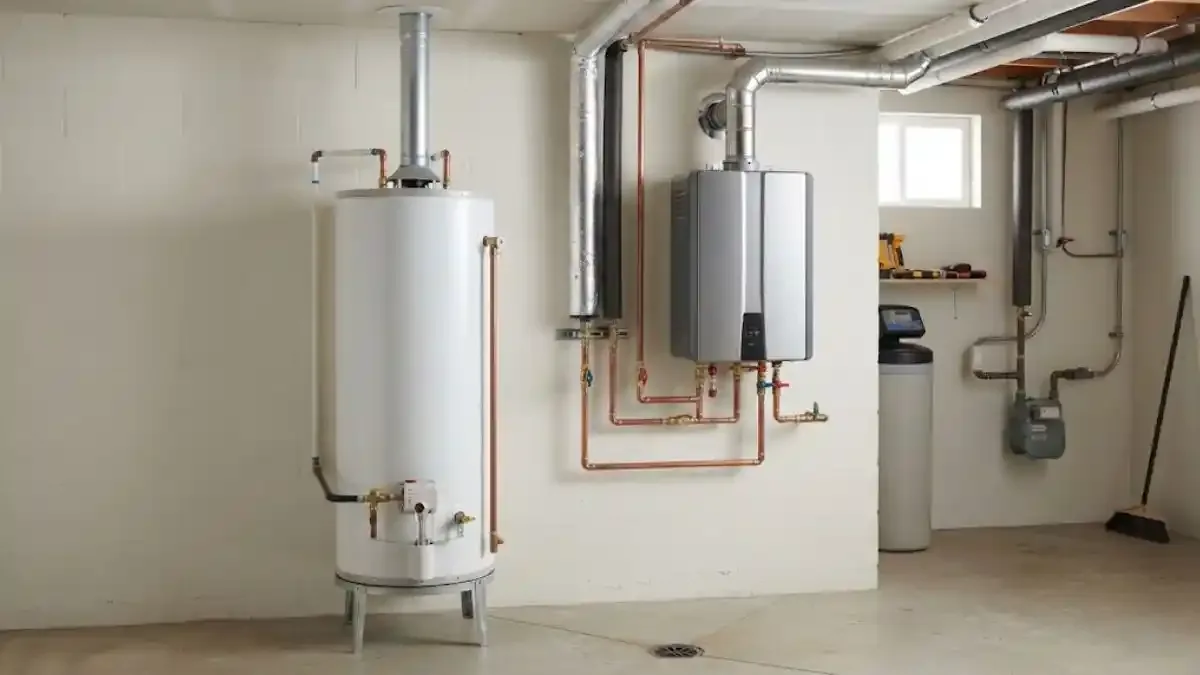
What a tankless water heater is, and who it suits
A tankless water heater heats water only when a tap opens, passing it through a gas burner or electric elements and a heat exchanger instead of storing 40 or 50 gallons. It never runs out during a single long shower, and it frees the floor space a tank takes. It cannot, however, deliver unlimited flow, which is where most disappointments begin.
Tankless works best when the unit is correctly sized, the gas or electrical supply can feed it, the vent is right, and the water is kept free of mineral scale. Skip any of those and the heater runs hot and cold, throws error codes, or dies early. We handle installs, repairs and maintenance flushes on both gas and electric models.
Tankless installs have to meet the California Plumbing Code, based on the Uniform Plumbing Code (UPC), along with the manufacturer's venting and gas sizing instructions, which is why the gas line gets checked before anything is hung on the wall.
Why does my shower go hot, cold, hot again?
That swing has a name among plumbers, the cold-water sandwich, and scale is behind many of the calls we hear about it.
Cold-water sandwich
When you shut a tap briefly and reopen it, the burner stops and the water sitting in the heat exchanger and pipes cools. That cold slug is pushed out first, ahead of fresh hot water once the unit relights. Hot, cold, hot is the pattern. A recirculation line or small buffer tank shortens it.
Scale on the heat exchanger
Hard water leaves calcium on the heat exchanger. The coating slows heat transfer, so the unit needs more time to hit the set temperature, and the flow sensor can misread. The result is lukewarm water, fluctuations, and error codes tied to temperature or flow.
Clogged inlet screen
A small filter screen on the cold inlet catches debris. When it clogs, flow drops and the unit may not fire at low demand. Cleaning it is a ten-minute job once the unit is isolated.
Undersized unit
If two showers and a dishwasher pull more gallons per minute than the heater can warm, the water temperature drops across the house. No flush fixes this one, since the sizing is the problem.
Manhattan Beach water is hard enough that scale is a regular feature of tankless ownership. The City's 2023 Annual Water Quality Report lists groundwater at 392 mg/L average total hardness and imported water at 136 mg/L, so your tap blend determines how fast the exchanger builds a crust. Over in Redondo Beach, Cal Water reports 560 ppm hardness in its groundwater, so the same scale rules apply there.
Sizing a tankless unit by flow and temperature rise
Two numbers decide whether a tankless heater is big enough: how many gallons per minute (gpm) you need at once, and how many degrees the water has to climb.
| Fixture | Typical flow | Common to run at once? |
|---|---|---|
| Shower | about 2.0 to 2.5 gpm | Yes, often two at a time |
| Bathroom faucet | about 1.0 to 1.5 gpm | Sometimes |
| Kitchen faucet | about 1.5 to 2.2 gpm | Often with a dishwasher |
| Dishwasher | about 1.5 gpm | Usually overnight or after dinner |
| Clothes washer (hot) | about 2.0 gpm | Weekends and laundry days |
| Soaking tub fill | about 4 to 8 gpm | Rarely with a shower |
Add the fixtures you run together, then work out temperature rise: the target (usually about 120 degrees Fahrenheit) minus your incoming water temperature. A 5 gpm demand with a 60-degree rise needs about 150,000 BTU per hour of delivered heat, since each gallon-per-minute per degree takes roughly 500 BTU per hour. Units list their maximum rise at a given flow, so always check the manufacturer's performance chart for the colder winter water.
What to do before the plumber arrives
These steps limit damage and keep you safe while the dispatch line gets a plumber moving.
- Smell gas? Leave first
Leave on foot, call SoCalGas at 1-800-427-2200 from a safe distance, or 911 if life or property is at risk. Do not flip switches or use a phone near the leak.
- Shut the heater's gas control and cold-water valve only if it is safe
If there is no gas smell, turn the unit's control to off and close the cold supply so a leak stops growing.
- Do not relight, bypass or reset repeatedly
Repeated lockouts and error codes mean something upstream needs a plumber, not another try.
Signs a tankless heater needs service
Most failures announce themselves. These are the ones to act on.
- Error codes on the display
Codes point to ignition, flow, temperature or exhaust faults. The manual's list narrows it down, but the same code can come from scale, a sensor or a vent obstruction.
- Water that never reaches the set temperature
A scaled exchanger, a failing flow sensor or a gas supply that is too small can all keep a unit under target. Measuring gas pressure and checking the exchanger separates the causes.
- Loud rumbling, clicking or banging
Scale causes steam bubbles inside the exchanger, and a failing fan makes a different grinding sound. Either is worth a service visit.
- Water leaks at the unit
Leaks at the isolation valves are minor. Leaks from the heat exchanger or a condensate line need immediate attention, and a pooling puddle under a unit is an urgent call.
- Reduced flow only on the hot side
A clogged inlet screen or a scaled exchanger restricts flow before water reaches the fixtures. Cold flow stays normal, which is the clue.
How a descaling flush works
A flush dissolves mineral buildup so the heat exchanger works like new again. Many manufacturers ask for one yearly in hard water.
- 1
Isolate the unit
Service valves on the cold and hot lines let us shut the unit off from the house. Without them, a flush is difficult, which is why we recommend adding isolation valves at install.
- 2
Circulate the descaler
A small pump pushes an approved descaling solution (typically a food-grade acid such as white vinegar or a descaler the maker specifies) through the exchanger in a loop for roughly 45 minutes to an hour.
- 3
Rinse and clean the screen
Fresh water runs through until it is clear, and the inlet screen is pulled and cleaned.
- 4
Restore and test
The valves are reopened, air is purged, the unit is fired and checked at the display, and we confirm temperature and flow.
If you have a water softener, scale slows dramatically, and our water softener and filtration page explains how softening works.
Gas line, venting and electrical needs
Tankless installs often run into infrastructure rather than the heater itself. These are general considerations, and each home needs its own measurement.
Gas supply
A gas tankless unit may draw several times the BTU input of a tank heater, so the existing gas line can be too small. The line size, length and meter capacity decide it, and the gas piping is sized by a licensed plumber.
Venting
Condensing models use plastic exhaust pipe and need a condensate drain, while non-condensing units need stainless vent. Terminations need clearance from windows and openings, and the manufacturer's manual sets the rules.
Electrical
Gas units still need a small 120-volt supply for the controls and fan. Electric tankless units draw very high amperage, often exceeding what an older panel can handle, so a panel assessment is part of the plan.
Whenever gas piping, venting or electrical changes are part of the plan, permit rules vary, so ask the Manhattan Beach Community Development / building department what your project requires.
Thinking about tankless?
Tell us the household and the fixtures you run together, and we will walk through the sizing.
Tankless repair or tank replacement?
A tankless heater that is failing has options a tank does not. If the exchanger is the failure, we compare a new unit with a new tank install, and if only a sensor or fan is the culprit, our water heater repair service covers the fix.
| Fault | Typical fix | Notes |
|---|---|---|
| Scale and lukewarm output | Descaling flush, clean inlet screen | Often resolves the problem if the unit is otherwise sound |
| Ignition or flame sensor fault | Clean or replace sensor, check gas pressure | Usually a modest repair |
| Fan or exhaust fault | Replace fan, clear vent | Check the vent termination for blockage |
| Flow sensor fault | Replace sensor or clean the inlet screen | Common on scaled units |
| Heat exchanger leak | Replace exchanger or unit | Often the point where replacement is cheaper |
What affects the cost of a tankless water heater job
Tankless work spans a simple flush to a full fuel and venting rework.
Gas, electric, condensing and non-condensing units differ in price, and capacity sets the heat exchanger size.
A larger gas line or a meter review is separate from the heater.
New vent runs or condensate lines change materials and labor.
Electric units may need new breakers, wire or a panel check.
A flush on a neglected unit takes longer than one on a unit with isolation valves and a record of upkeep.
Insurance generally does not cover wear or scale. Sudden burst damage is a different matter, so ask your insurer.
FAQs
Tankless water heater questions
Many tankless units are rated for 15 to 20 years or more with regular descaling. In hard water without maintenance, life drops sharply.
Not strictly, but scale is the main enemy. Without softening, plan on yearly flushes. With softening, the interval stretches. Test your tap hardness before deciding.
Sometimes. A tankless unit draws more gas than a tank, so the line size, the run length and the meter capacity are checked first.
Many units need a minimum flow, often around 0.5 gpm, to fire. Opening a tap just a little can leave the burner off, which feels like cold water.
It is the brief cold slug between two bursts of hot water, caused by the heater turning off and on when you pause a tap. A recirculation setup or a small buffer tank reduces it.
Yearly is a common recommendation, and the interval depends on hardness and use. Follow the manufacturer's manual and adjust for your local hard water.