
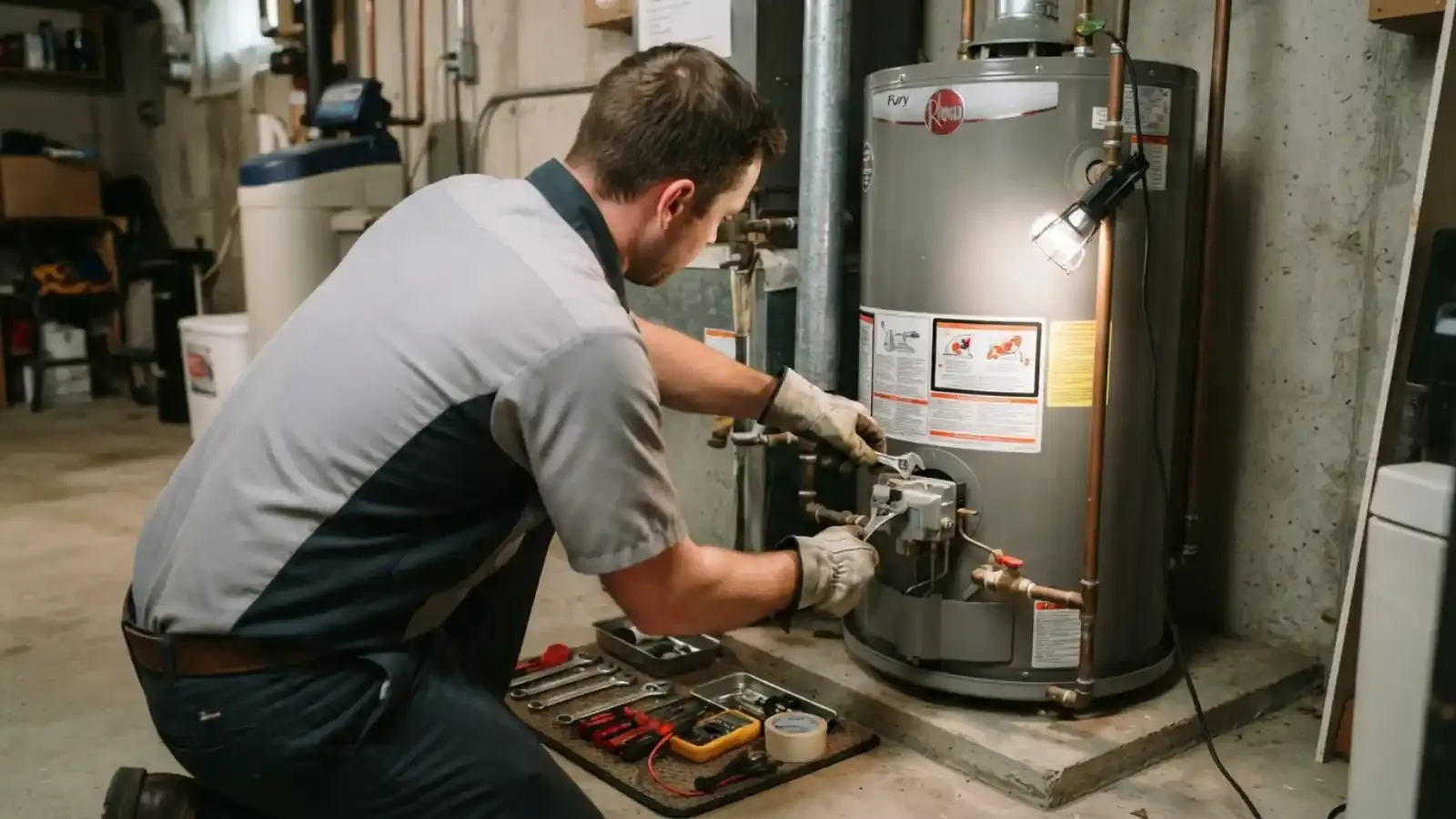
What water heater repair actually covers
Water heater repair is the diagnosis and replacement of a failed component inside a tank or heat pump unit so the heater makes hot water again without replacing the whole appliance. The usual suspects are a pilot assembly or thermocouple on gas models, a heating element or thermostat on electric models, a worn anode rod, a stuck temperature and pressure relief valve, and a failing gas control valve.
Plenty of calls sound like one problem and turn out to be another. Lukewarm water might be a burnt lower element, a tripped high-limit switch or a dip tube that has crumbled. A puddle might be a loose drain valve, a weeping fitting on top, or a tank wall that has rusted through. Only the second kind of leak ends the heater's life.
We start by sorting the failure into fixable or finished, because that decides everything that follows. If one inexpensive part brings the heater back to normal, repairing it is the sensible move. If the steel has failed, we say so and walk you through replacing the unit instead.
When a water heater is leaking, scorching or smells like gas
A water heater that is flooding a garage, closet or hallway cannot wait for next week, and neither can one that smells of gas or whose relief valve is blowing steam. Our 24/7 line takes these calls at any hour, and the steps below keep the damage small until a plumber reaches you.
A slow weep at the base or a pilot that will not light is less dramatic, but it is still worth a same-day look if the household has no hot water. Give the dispatcher the fuel type, the tank size on the rating label and where the water is landing.
While you wait for the plumber
- Gas smell, hissing or a rotten-egg odor: leave on foot, do not touch switches or the garage door opener, and call SoCalGas at 1-800-427-2200 or 911 from outside. Do not try to relight anything.
- Water on the floor: close the cold supply valve on top of the tank (a quarter-turn lever or a round handle). If it will not turn, close the main shutoff at the street side of the house.
- Electric heater: switch the dedicated 240-volt breaker off before you go near a wet tank. Gas heater: turn the gas control knob to OFF or the pilot position only if the area is dry and has no gas smell.
- Steam or hot water from the discharge pipe: keep children and pets away, shut off the fuel supply, and do not cap or plug the relief valve.
- Move rugs, boxes and anything stored on the floor out of the wet zone, and photograph the label, the leak and the damage for your insurer.
Gas, electric and heat pump heaters fail in different ways
The fuel decides which parts wear out first, so the first question on any call is what the heater burns or draws. Each type has a short list of parts that cause most no-hot-water complaints.
Gas tank heaters
A standing-pilot model relies on a thermocouple, a small copper probe that sits in the pilot flame and holds the gas valve open. When the probe weakens or the pilot orifice clogs, the flame drops out and the heater goes cold. Newer units use electronic ignition and a flame sensor, which foul with soot instead.
Gas models also fail through the flue. A weak draft, a loose vent connection or a backdrafting hood lets combustion gases spill into the room, which is a carbon monoxide problem and not just a comfort issue.
Electric tank heaters
Two screw-in elements, upper and lower, do the heating, each controlled by its own thermostat behind an access panel. A dead lower element gives you a small amount of hot water that runs out fast. A dead upper element usually means no hot water at all.
A tripped high-limit button (the red ECO reset) points to a thermostat or element shorting out. Resetting it without finding the cause just delays the next trip.
Hybrid and heat pump heaters
A hybrid unit pulls heat from the surrounding air with a small compressor and falls back on resistance elements when demand is high. Common repairs include a clogged air filter, a blocked condensate drain, a failed fan, and fault codes tied to the temperature sensors.
The sealed refrigerant side needs a technician with the right equipment, so a unit that runs but never heats in heat pump mode is diagnosed before anyone orders parts. Many hybrids keep working on the elements, which is why a bill spike can be the only clue.
Symptoms and what each one usually points to
Describe what you see and hear when you call. These pairings are starting points, and the diagnosis at the tank confirms or overrules them.
- Pilot light keeps going out
On a standing-pilot gas heater, the thermocouple is the first suspect, followed by a dirty pilot tube, a draft blowing across the burner compartment, or a gas control valve that has stopped responding.
- Lukewarm water that runs out quickly
On an electric heater, this is the classic burnt-out lower element. On gas, it is often sediment packed around the burner zone, or a broken dip tube mixing cold water into the top of the tank.
- Rumbling, popping or knocking from the tank
Mineral scale settles on the tank bottom, traps water under it, and the water flashes to steam beneath the crust. It wastes fuel, overheats the lower tank wall, and often shortens tank life.
- Rust-colored or metallic-smelling hot water
If only the hot side is brown or smells like rotten eggs, the anode rod has usually been consumed and the steel is next. Replacing a rod early can extend a sound tank, and replacing it late rarely helps.
- Water dripping from the discharge pipe
The temperature and pressure relief valve has opened. That can be a failing valve, excess thermal expansion in a closed system, or street pressure that is too high. Test-lifting the lever is a job for the plumber, not a fix.
- Water pooling under the tank
Check the drain valve, the top fittings and the relief valve first, because those are repairable. A seam leak or weeping through the jacket means the inner tank has corroded through, and repair is off the table.
- Breaker trips or a burning smell on an electric unit
Turn the breaker off and leave the unit alone. A shorted element, a damaged thermostat or a wet terminal block needs inspection before the heater is powered again.
Manhattan Beach note
What Manhattan Beach water does inside your tank
The City of Manhattan Beach supplies a blend of locally pumped groundwater and treated imported water. According to the City's 2023 Annual Water Quality Report, the groundwater averages 392 mg/L of total hardness, roughly 23 grains per gallon, while the imported water averages 136 mg/L, roughly 8. Your tap gets some mix of the two, and the mix changes.
A heater fed mostly by the harder source builds scale on the bottom of the tank and on electric elements faster. That scale insulates the water from the burner or element, so you pay for heat that never reaches the water. Flushing the tank and checking the anode rod on a schedule matter more here than the owner's manual suggests.
Coastal garages add a second pressure. Salt air attacks the exposed steel of the vent connector, gas flex line and jacket base, so a heater that lives near the Strand deserves a look at those outside surfaces, not only the tank.
Sources: City of Manhattan Beach
How we find the failed part
A confident repair starts with measurements, not a guess and a parts swap. Here is the order we work in.
- 1
Read the label and the symptoms
The rating plate gives the fuel, capacity, model and date code, which tells us the age and which parts fit. We ask what the household noticed first, because a story that starts with a smell is handled differently from one that starts with a cold shower.
- 2
Test before touching
On gas units we use a combustible gas detector at the gas valve and fittings, check the flame pattern, and test draft at the hood. On electric units a multimeter checks incoming voltage and element resistance. A 4,500-watt element typically reads in the low teens of ohms, and an open circuit reads infinity.
- 3
Check pressure and the safety valve
A pressure gauge on a hose bib shows static street pressure. High pressure (above roughly 80 psi) stresses the tank, fittings and relief valve. We also confirm the T&P valve and its discharge pipe are intact, since that valve is the last line of defense against an overheated tank.
- 4
Quote the fix, then do it
You get the failed part, the repair, the alternatives and the price before work starts. If the tank wall is the failure, we explain it with what we found so the decision does not feel like a pitch.
Common repairs and their honest trade-offs
Some repairs restore years of service. Others are worth doing only when the tank itself is healthy.
| Part or fault | What fixes it | Worth it when | Watch out for |
|---|---|---|---|
| Thermocouple or flame sensor | Replace the probe, clean the pilot assembly | The tank is sound and under about 10 years | A second failure within months points to the gas valve |
| Heating element or thermostat | Replace the element, gasket and thermostat as needed | The tank holds water and does not leak | Elements burn out fast if the tank is full of scale |
| Anode rod | Swap the sacrificial rod, flush the tank | The heater is mid-life and the rust has not reached the steel | A rod stuck with scale may need a flexible rod or impact tool |
| T&P relief valve | Replace the valve and check the discharge pipe | The valve is dripping or stuck | Repeated discharge means pressure or expansion problems, not just a bad valve |
| Gas control valve | Replace the valve assembly | The tank is young and the part is available | On older tanks the valve can cost close to a new heater |
| Drain valve or fitting leak | Replace the valve or reseal the fitting | Water comes from a fitting, not the tank wall | Plastic drain valves crack when forced shut |
| Heat pump fault or sensor | Clean filter and drain, replace fan or sensor | Fault code or airflow problem is found | Sealed system leaks usually favor replacement |
When the repair estimate climbs toward the price of a new unit, we say so before you decide. The side-by-side comparison lives on our water heater replacement page.
Cold water and not sure why?
Tell us what you see and hear, and we will say whether it sounds like a part or a tank.
Earthquake bracing is part of the repair visit
California Health and Safety Code section 19211 requires all new and replacement water heaters, and all existing residential water heaters, to be braced, anchored or strapped against falling or horizontal displacement in an earthquake. It applies to standard units of 120 gallons or less for which a preengineered strapping kit is readily available, at minimum to the California Plumbing Code or local modifications.
A toppled heater tears the gas flex line or the water connectors and starts a leak or a gas release at the worst moment. When we open a heater for repair, we check the straps, the anchor screws into the studs, and the flexible connectors, and we tell you what is missing. A strap that has slid down or a heater that has been moved since the last install is a frequent finding.
Permit rules vary by job, so ask the Manhattan Beach Community Development / building department what your specific repair or swap needs.
Keeping a repaired heater alive longer
A good repair can buy several more years if the underlying cause is addressed. Three habits do most of the work.
Flush the tank
Draining a few gallons from the drain valve once a year pulls out loose sediment before it hardens into a crust. Heaters that have never been flushed may have a drain valve clogged with scale, so we sometimes handle the first flush.
Replace the anode rod
The rod is magnesium or aluminum and corrodes in place of the tank steel. Many are consumed within several years in hard water, and a rod that is gone leaves the tank to rust. Checking takes a 1-1/16 inch socket and some clearance above the tank.
Set the thermostat sensibly
Around 120 degrees Fahrenheit balances scald risk against comfort and slows scale formation. Higher settings speed mineral buildup and stress the tank, and a heater stuck at its limit points to a thermostat or valve fault.
What drives the cost of a water heater repair
We do not publish a flat number because the failed part, the tank age and the access change the work. What we do promise is a clear price before work starts.
A thermocouple, an element and a gas control valve are three very different jobs. The part, its availability and the labor to reach it set most of the bill.
Heat pump models and condensing gas units carry more expensive parts and more diagnostic time than a standard 40 or 50 gallon tank.
Repair on a tank at the end of its life can be money spent twice. We weigh the age on the label and any rust before recommending it.
A heater in an open garage is a short job. One boxed into a closet, a crawl space or a tight utility room takes longer to service safely.
Missing bracing, a damaged discharge pipe or a worn gas connector can add work. We list these separately so you can see what is repair and what is correction.
Insurance often covers sudden damage from a burst or failed tank, but typically not a slow leak or wear and tear. Ask your insurer before the repair, and keep photos and the old part.
Landlords, rentals and shared heaters
Rental units and multifamily buildings add a few wrinkles that homeowners rarely face.
Tenants without hot water
Hot water is a habitability matter in a rental, so a failed heater should be handled quickly. We coordinate with the property manager when they need to approve the work, and we leave the invoice details that the owner needs.
Shared or central heaters
Multifamily buildings may run a bank of tanks or a boiler with a circulation loop. Diagnosis then covers the pump, the return line and the mixing valve as well as the heater, and our commercial plumbing team can take larger systems.
FAQs
Water heater repair questions
Yes. The dispatch line is open around the clock, including nights, weekends and holidays, and a leaking tank, a gas odor report or a blowing relief valve gets handled as urgent. For a gas smell, leave the building and call SoCalGas first.
For a no-hot-water call with no leak, we offer same-day appointments when the schedule allows, and the dispatcher tells you honestly what is available.
It depends on where the water comes from. Leaks at the drain valve, the supply fittings, the T&P valve or the element gasket are repairable. A leak from the tank seam or the jacket means the inner tank has rusted through, and replacement is the only real answer.
A weak thermocouple, a clogged pilot tube, a draft in the burner compartment or a faulty gas control valve are the usual causes. Because a pilot that will not hold can also signal poor venting, we check draft before relighting rather than just resetting it.
A burnt lower element is the most common cause, since the lower element does most of the heating. A failed thermostat, a tripped high-limit reset or a broken dip tube can produce the same symptom.
Yes. Beyond the tank and elements, they have a compressor, fan, evaporator coil, filter and condensate drain. Many faults are simple, like a clogged filter or a blocked drain line, but anything involving the sealed refrigerant circuit takes specialized equipment.
California Health and Safety Code 19211 requires new, replacement and existing residential water heaters to be braced, anchored or strapped. We check the straps during any visit and can add them. Ask the Manhattan Beach building department about permit details for your job.
Following the label on the tank is reasonable if there is no gas smell and the heater is otherwise in good shape. If the pilot will not stay lit, the cause is a part or a venting problem, and repeated relighting only masks it.
A yearly flush and a rod inspection every few years is a sensible rhythm, sooner if your water is on the hard side. Manhattan Beach groundwater averages 392 mg/L hardness, so scale and rod wear can move faster here than the manual assumes.