
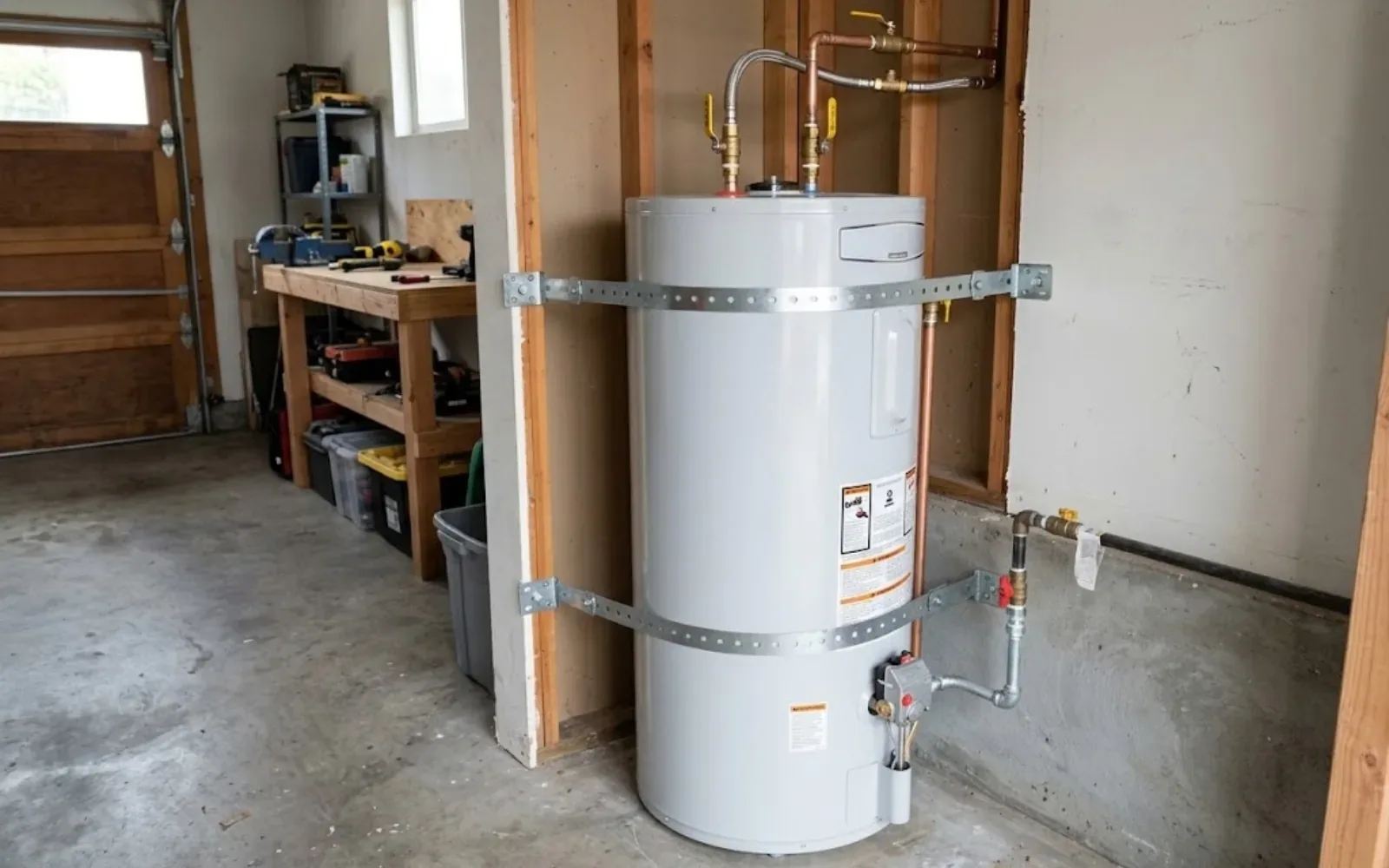
Replacing a failed tank, start to finish
Water heater replacement means removing a failed or worn-out heater and installing a new one, including the water, fuel, venting and safety connections that make it legal and safe to run. In an emergency, it is the repair for a tank whose steel has rusted through. No gasket, valve or element can fix a hole in the pressure vessel.
A good swap is more than lifting a tank into the old footprint. The connectors, shutoff valves, relief valve discharge pipe and earthquake straps all have a job, and the old ones are rarely worth reusing. We replace them as part of the visit and list each item so you see what the price covers.
If the heater is merely misbehaving, you may be better served by a repair visit first. If you are planning ahead and nothing has failed, our water heater installation page covers the options at a slower pace.
When the tank has split and water is spreading
A tank that has failed at the seam can release 40 to 50 gallons in a short time, and a 75-gallon unit holds more. Water that reaches drywall, flooring or a neighbor's unit multiplies the cost fast, so shut the supply and call right away. Our 24/7 line connects you with a plumber who can book an after-hours or same-day visit when one is available.
Do not wait for a slow leak to resolve itself. A heater leaking from the bottom is finished, and the question is only how soon it is replaced.
While you wait for the plumber
- Close the cold water supply valve at the top of the tank. If the valve is frozen or leaks, close the home's main shutoff instead.
- Turn off the heat source. On electric heaters, switch off the dedicated breaker. On gas heaters, set the gas control to OFF if the area is dry, and stay out if you smell gas.
- Open one hot faucet upstairs to let air in, which helps the tank drain if you decide to empty it. Run a hose from the drain valve to a floor drain or the yard only if the water is not scalding.
- Dry the area, lift stored items and run fans. Photograph the label, the leak and any wet materials for your insurer.
- Gas odor or hissing: leave on foot and call SoCalGas at 1-800-427-2200 or 911 from outside. Do not turn anything on or off.
Repair or replace? A decision table
The line between fixing and replacing is not mysterious. Age, location of the failure and the cost of the part decide it.
| What you found | Lean toward | Why |
|---|---|---|
| Water pooling from the tank seam or under the jacket | Replace | The inner tank has corroded through and nothing patches it |
| Dripping from the T&P valve or a fitting, tank dry underneath | Repair | The valve or fitting is a small part on a sound tank |
| No hot water, tank is under about 8 years, element or thermocouple suspected | Repair | A small part on a young tank is usually worth saving |
| Tank is past 12 years with rust at the bottom or rusty hot water | Replace | The anode is gone and the steel is next to fail |
| Repair quote is more than about half the cost of a new unit | Replace | You would pay twice for a tank near the end of its life |
| Heavy scale rumbling, repeated element failures, drain valve clogged | Replace, or flush if young | Thick sediment shortens life and cuts efficiency |
| Gas heater with draft or venting problems on an old unit | Replace | New venting can be done during the swap |
The ages above are typical, not a promise. A tank with good water and a fresh anode rod can outlast its label, and a neglected one in hard water can fail early.
Signs the heater is done
These signs, alone or together, tell us a tank has reached the end of its life.
- Water at the base that comes from the tank itself
Once the leak comes through the jacket or the seam, the inner steel has failed. A plumber may still check the fittings above to be sure, but a wet tank bottom is almost always final.
- Rusty hot water, with clean cold water
If cold taps run clear and hot taps run brown, the corrosion is inside the tank. Draining a few gallons from the drain valve shows flakes of rust or a gritty sediment.
- Repeated pilot, element or thermostat failures
A parts list that keeps growing signals a tank that is wearing out all at once. Stacking repairs on an old heater costs more than one clean swap.
- Constant rumbling and slow recovery
A crust of scale on the tank floor insulates the water from the burner or element. Efficiency drops, and the overheated steel under the crust eventually cracks.
- A tank that has simply reached 12 years or more
Many warranties run six years, and many tanks last past that. Once a heater is well beyond its label, planning the swap on your schedule beats being forced into it at midnight.
What happens during a replacement visit
The process is the same whether the swap is an emergency or booked days ahead. Only the speed changes.
- 1
Confirm the failure and the footprint
We verify the tank is the problem, check the label for fuel and capacity, and measure the space. A swap into the same spot should keep the same capacity, but this is also the time to size up or down if the household has changed.
- 2
Drain, disconnect and haul
The fuel and water are shut off, the tank is drained to a floor drain or outside, and the connections are broken. The old unit leaves with us, which is a real relief in a garage the size of a closet.
- 3
Set, connect and secure
The new heater goes on a drain pan where the location calls for one. We fit new flexible connectors, shutoff valves, a T&P discharge pipe, and straps anchored into the studs. Gas models get a proper gas shutoff and sediment trap, and the flue is checked for draft.
- 4
Fill, purge, test and explain
The tank is filled with a hot tap open so air leaves the lines, then fuel is restored, the burner or elements are tested, and the temperature is set. We show you the shutoff, the relief valve and the drain, and explain what to do next time.
Which type of replacement heater fits your home
Fuel is the biggest decision. Swapping like for like is the fastest route, while changing fuels adds electrical or gas work.
Standard gas tank
Replaces most older gas heaters with the fewest changes. The existing gas line and venting are reused when they pass inspection. It has the fastest recovery of the tank options, and it needs a clear path for combustion air and exhaust.
Standard electric tank
Needs a dedicated 240-volt circuit and no venting, which makes it a flexible choice for closets and interior utility rooms. The trade-off is slower recovery and higher operating cost compared with gas in many homes.
Hybrid heat pump tank
Uses a fraction of the electricity of a standard electric unit by moving heat from the surrounding air. It needs enough open air around it, a condensate drain and clearance for service, and it cools and dries the room it sits in.
Tankless as a step up
A tankless unit removes the storage tank entirely and has its own gas, venting and descaling needs. If you are weighing it, our tankless water heater page explains sizing and maintenance.
Need the swap done today?
Give us the fuel, tank size and location, and we will confirm what can be done and when.
The expansion tank, and why it comes up
When a water heater heats cold water, the water expands. In an open system that extra volume pushes back into the street main. If the home has a check valve, a backflow preventer or a pressure reducing valve (PRV) that blocks the return path, the expansion has nowhere to go and the pressure spikes.
An expansion tank is a small tank on the cold line with an air cushion behind a diaphragm. It absorbs the surge so the T&P valve, fittings and fixtures do not take the hit. The air charge is set to match static house pressure, commonly checked with a tire gauge before installation, and the tank is sized to the heater's volume.
Signs that the system needs one include a T&P valve that drips after heating cycles, banging pipes when the heater fires, and a PRV that was added without any expansion allowance. We test pressure with a gauge before recommending one, because not every home needs it.
Bracing, permits and code on a replacement
California Health and Safety Code section 19211 requires all new and replacement water heaters to be braced, anchored or strapped against displacement in an earthquake, at minimum per the California Plumbing Code or local modifications. It covers standard units of 120 gallons or less where a preengineered strapping kit is readily available.
For us that means two straps around the upper and lower thirds of the tank, anchored into wall studs or the proper blocking, with the lower strap above the controls. A heater in the middle of a room is a different problem and needs a purpose-built solution. A toppled tank breaks the gas flex or the water connectors, which is why bracing is part of the price and not an extra.
Permit rules vary, so ask the Manhattan Beach Community Development / building department what your swap requires. Whoever you hire, verify the contractor's license at cslb.ca.gov. A California contractor license is required for jobs of $1,000 or more, and CSLB advises paying no more than 10 percent down or $1,000, whichever is less.
Manhattan Beach note
Hard water and your next tank in Manhattan Beach
The City's 2023 Annual Water Quality Report lists groundwater at 392 mg/L average hardness and imported water at 136 mg/L. Because the blend varies, scale pressure on a new heater varies too, and so does the benefit of a softener or periodic flushing.
Wherever the heater sits, access sets the labor. On steep Hill Section streets, parking and stairs can turn the carry of a 100-pound tank into a longer job, and near the beach, salt air eats at exposed vent pipe and gas fittings. We ask about location when you call so the right crew and parts arrive.
If the old tank died young, ask us about the water. A water softener or filter can slow scale on the next heater, and a flush schedule helps whether or not you soften.
Sources: City of Manhattan Beach
What sets the price of a water heater replacement
Prices swing a lot based on the job. We will not guess a number on this page, and you will get one before we start.
A 40-gallon standard tank and a 65-gallon heat pump unit sit in different price ranges, and so do the installs.
Gas to electric or electric to heat pump can require a new circuit, a panel check or capping a gas line. A like-for-like swap avoids all of it.
Old flue pipe, a missing sediment trap or an undersized gas line adds work. Power-vent and condensing units add their own venting materials.
Attic, crawl space, stairs, tight closets and long carry distances add time. A garage on grade is the simple case.
Straps, expansion tank, pan and discharge piping are common additions. We list each so you can see which items the code or the building department asks for.
Insurance often covers sudden burst damage from a failed tank, but not the heater itself when it wore out. Ask your insurer and keep your photos.
FAQs
Water heater replacement questions
Yes. Our dispatch line is staffed around the clock, and a failed tank that is actively leaking is treated as urgent. Same-day installs are offered when the schedule and the right heater are available, and the dispatcher tells you honestly what can be done tonight versus the next morning.
A like-for-like swap in an accessible spot is often done in a few hours. Fuel conversions, new venting, and tight access can stretch it. Ask the dispatcher about your situation when you call.
It depends on whether your system is closed. With a PRV or check valve on the supply, thermal expansion has nowhere to go, and a small tank on the cold line protects the fittings and the T&P valve. We test pressure before recommending one.
Yes. Health and Safety Code section 19211 requires new and replacement water heaters to be braced, anchored or strapped. We include proper strapping on every swap.
Permit rules vary by job. Ask the Manhattan Beach Community Development / building department what your specific swap requires, and we will tell you what we see on site.
Often, yes, but it is more than a swap. A heat pump unit needs a 240-volt circuit, enough open air or ducting, and a condensate drain. Check the model's spec sheet and have the panel assessed first.
We drain it, disconnect it and haul it away with the install. You do not need to arrange a pickup.