
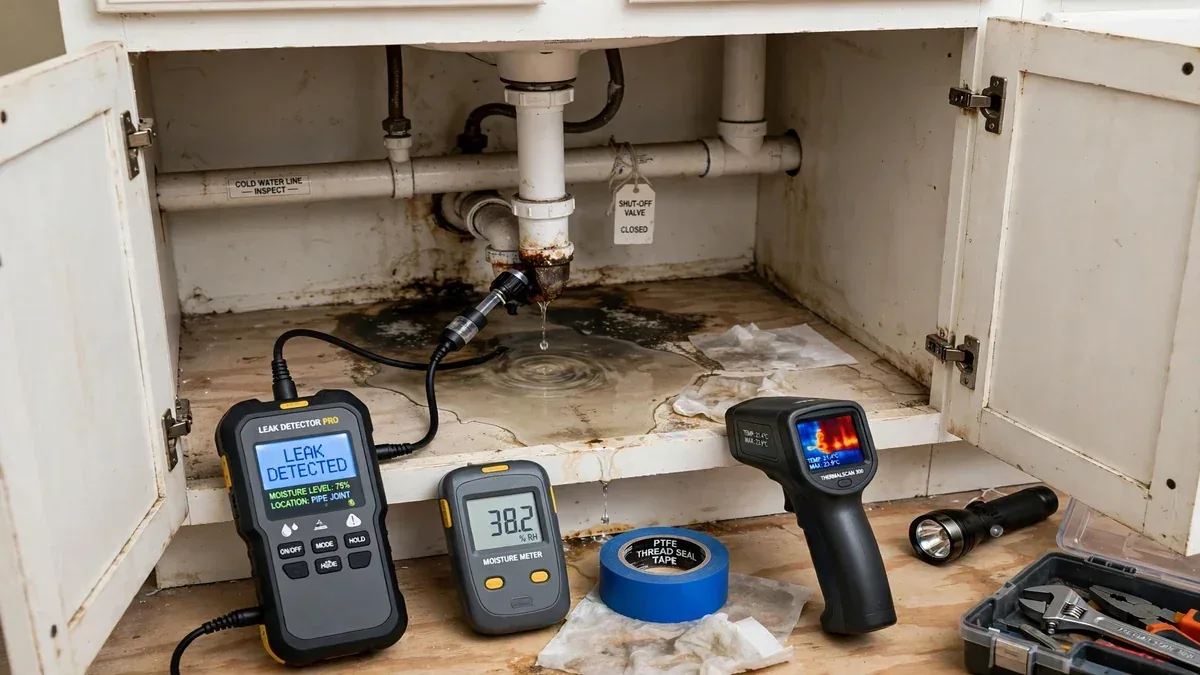
What a high water bill leak check actually means
A high water bill leak check is a short set of tests that separates real water loss from higher use. The goal is to learn whether water is moving through your pipes when nobody is using it, and if so, roughly where.
Most spikes come from one of five places: a toilet that never fully seals, a dripping or open outdoor line, an irrigation zone stuck on, a water heater relief valve, or a buried pipe leaking between the meter and the house. Four of those you can check yourself with a flashlight and a phone camera.
The fifth is the one that hurts. A pinhole in a copper line under a slab can lose hundreds of gallons a day with no wet spot anywhere. That is why we start with the meter, because it counts water no matter where it escapes.
If the leak turns out to be on a pressurized line, the repair has to follow the California Plumbing Code, which is based on the Uniform Plumbing Code (UPC).
Read the meter before you touch anything
Your meter is the one honest witness in the house. Plan on ten minutes, and make sure nobody runs water during the test.
- 1
Find and open the meter box
It is usually in a ground-level box near the curb or along the front property line. Lift the lid with a screwdriver and brush off any dirt or spider webs. Wear gloves, since small creatures like the shade.
- 2
Locate the leak indicator and the sweep dial
Most residential meters have a small triangle or star that spins with even tiny flow, plus a low-flow dial and a row of odometer digits. Units are often cubic feet or gallons, so ask the City Utilities office what yours reads if the face is unclear.
- 3
Shut every fixture and note the numbers
Turn off the dishwasher, washer, ice maker and irrigation. Make sure no toilet is mid-fill. Photograph the dial and digits, wait 30 minutes with no use, then photograph again.
- 4
Compare the two photos
A spinning indicator or higher digits means water is leaving the system. A still meter means the bill problem is use, timing or billing. If the dial moves, close the main shutoff at the house and check the indicator again to learn which side of the valve the leak is on.
What the meter result tells you
Once you have both photos, this table turns the result into a next step.
| Meter behavior | Main shutoff closed | Most likely cause | Next step |
|---|---|---|---|
| Moves with all fixtures off | Stops moving | Leak inside the house: toilet, fixture, water heater valve, or hidden supply line | Dye test toilets, check under sinks, then call for pressure testing |
| Moves with all fixtures off | Keeps moving | Leak between the meter and the house shutoff: service line or yard line | Walk the line for soggy ground, then call for a locate |
| Barely creeps, slow indicator spin | Stops | Running toilet, dripping valve, small supply weep | Dye test and tighten or replace the part |
| Holds still | Not needed | Heavier use, irrigation schedule, billing period overlap | Review timers and call the City to verify read dates |
That second row is the one that often leads to a buried pipe. If the meter keeps turning after the main is closed, the loss is outside the building and the City cannot see it from their side.
Find the quiet leaks around the house
Before you assume the worst, work through these in order. Each takes a few minutes.
- Toilet dye test.
Remove the tank lid, drop in 10 drops of food coloring and do not flush for 15 minutes. Color in the bowl means the flapper is leaking. Many flappers wear out in a few years, and mineral deposits from hard water make the seat rough.
- Faucets and supply stops.
Open cabinet doors and run a dry paper towel along each supply line and angle stop. Green crust on a brass fitting or a damp towel tells you where to look.
- Water heater.
Look at the discharge pipe from the temperature and pressure relief valve. A trickle or a wet floor under the tank can mean a failing valve or high pressure. Do not cap that pipe.
- Irrigation.
Run each zone for a minute and watch for a geyser, a mushy patch or a spray head that never retracts. A single broken head can run for days with no one watching.
- Outdoor spigots, hose bibs and pool or spa fills.
A hose left in a bucket or a leaking bib vacuum breaker can pass a surprising amount of water overnight. Check them with the meter still logging.
Meter keeps moving after you close the main?
Tell us what it did and we will plan the right locating method before we arrive.
Slab leak, service line or yard line: how the clues differ
Hidden leaks leave different fingerprints. This is a pattern guide, not a diagnosis.
| Location | Clues you might notice | How it is confirmed |
|---|---|---|
| Under the slab | Warm spot on the floor, hot water running when no tap is open, sound of running water at night, unexplained damp baseboard | Acoustic ground microphone, thermal camera, then a pressure test on the isolated line |
| Service line (meter to house) | Meter runs with the main closed, soggy or green strip of lawn, drop in pressure | Isolate and pressure test, then electronic locate and a small excavation |
| In-yard irrigation branch | Wet patch that changes with timer days, sprinkler heads weak or spitting | Zone-by-zone run, valve check, pressure hold at the backflow device |
| Inside walls or ceilings | Stain or bubble in paint, musty smell, hum from the wall | Moisture meter, thermal imaging, targeted access |
If the meter says the leak is on your side and the clues suggest slab or service line, stop hunting and call. Cutting into concrete or trenching a yard on a guess costs far more than a proper locate.
If you rent or manage the property
A lot of high-bill calls come from tenants and landlords who each assume the other already knows. The fix is simple: document first, then report.
Photograph the meter dial and the date, write down what the all-fixtures-off test showed, and send both to the landlord or property manager by text or email. A tenant should not open walls or dig. A landlord or manager should schedule a plumber promptly, because a leaking line keeps billing until it is stopped.
For multifamily buildings and small commercial spaces, ask which meter serves which unit. One shared meter can hide a leak in a single apartment, so the test may need to be run building-wide with every unit's tap and toilet idle.
Manhattan Beach note
Manhattan Beach water bills and who to call at the City
In Manhattan Beach the City supplies your water, and it blends locally pumped groundwater with treated imported water bought from the Metropolitan Water District of Southern California. If your account is with the City, the City Utilities office is the right first call for questions about readings and billing dates. The number is (310) 802-5304, Monday to Friday, 8:00 to 4:30, and the after-hours call center is (310) 802-5000.
Hermosa Beach and Redondo Beach are different. Those cities are served by Cal Water's Hermosa-Redondo district, so a reader in either town should read their own bill to see who to call. The City can confirm your read, but any leak past your meter is your pipe to fix.
Sources: City of Manhattan Beach
What to tell the utility and the plumber
Have four things ready: the service address, the date and numbers from your two meter photos, whether the meter stopped when the main was closed, and the last bill that looked normal. With that, a utility rep can check whether the read was an estimate and a plumber can plan the right tools.
Ask the utility about any leak adjustment or billing review process, since policies vary and you will want the answer in writing. We cannot speak for what the City will credit. We can document the leak, the repair and the date it stopped so you have the paperwork.
A plumber who responds to a hidden-leak call should explain the locating method before work begins. Our leak detection visits use an acoustic ground microphone, a thermal camera and an isolated pressure test, and you get a clear price before any wall or slab is opened.
When to stop testing and call
Call if the meter moves with the main closed, if you smell damp from under a floor, if hot water is lukewarm at the tap with no reason, or if you see a wet strip between the meter and the house. A buried supply is the work of water line repair, and the sooner the section is isolated the less water you pay for.
Nearby towns have their own water systems and rules, so if your property is across the line, our crews also work in Hermosa Beach and Redondo Beach and will check which utility serves you. Close the main valve at the house if water is actively running, then call.
FAQs
High water bill questions
Compare the bill to the same months last year, then run the all-fixtures-off meter test. If the meter dial or leak indicator moves while nothing is running, water is escaping somewhere. If it holds still and the bill is still high, look at irrigation timers, guests, a new pool fill or a filling hot tub.
Yes. A worn flapper or a fill valve that never fully shuts lets water trickle into the bowl around the clock. It is quiet, it costs nothing to test with dye, and it is the most common single cause we would check first.
Call the City of Manhattan Beach Utilities office at (310) 802-5304, Monday to Friday, 8:00 to 4:30. After hours the City call center is (310) 802-5000. Tell them your service address and what the meter does with all fixtures off.
Report it to the landlord or property manager in writing the same day, with a photo of the meter and the date. Who pays depends on your lease and California tenant rules, so ask the landlord or a tenant resource. A written report protects you either way.
Policies often cover sudden, accidental water damage but may not cover a slow leak, wear or the cost of reaching the pipe. Ask your insurer before repairs, and keep the meter photos and any written findings.
Because the City supplies the water here, the City Utilities office can confirm your meter reading and billing dates. That rules out a read or timing issue in one phone call. If the meter really does move with everything off, the leak is on your side of it and the repair is yours to arrange.