
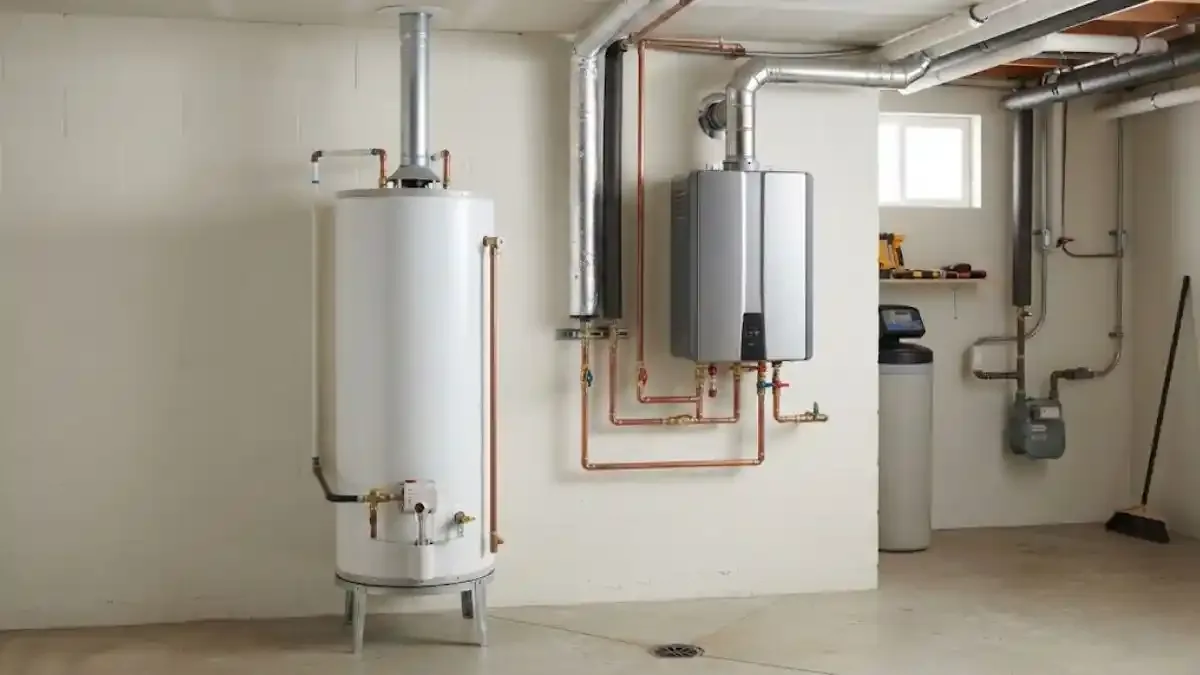
The short version: heat on demand, no stored tank
A tankless water heater, also called an on-demand heater, warms water only when you open a hot tap. A flow sensor notices water moving through the unit, the control board lights a burner (or energizes heating elements in an electric model), and a heat exchanger passes that heat into the water. Close the tap, the flow stops, and the burner shuts off.
That is the whole idea. It means no 40 or 50 gallon tank sits there keeping water hot all day, and the unit can run for as long as water and fuel keep flowing. The trade is that all the heating has to happen in the few seconds the water spends passing through the exchanger, so the unit must be sized for the flow you ask of it.
Most units are wall mounted, about the size of a carry-on suitcase, and they can go indoors or outdoors depending on the model and the venting.
What happens from tap to hot water
Each tankless cycle runs the same sequence. Knowing it helps you read an error code or a cold-water complaint later.
- 1
Water starts to flow
A turbine or flow sensor spins when cold water enters. Most gas units need a minimum flow, often around 0.4 to 0.5 gallons per minute, before they fire. A trickle from a half-open tap may not trigger the burner at all.
- 2
The control board starts the burner
The fan runs first to clear the combustion chamber, then the igniter lights the burner. Modulating gas valves adjust the flame so the outlet temperature stays near the set point even as the flow changes.
- 3
The heat exchanger transfers the heat
Water runs through finned copper or stainless tubes bathed in hot combustion gas. A thermistor reads the outlet temperature and the board trims the flame to match. Condensing units add a second exchanger that pulls extra heat from the exhaust.
- 4
Exhaust leaves through the vent
Combustion gases exit through a sealed vent pipe. That pipe, its length and its material are set by the manufacturer, and they are a major reason a tankless install costs more than a tank swap.
Condensing versus non-condensing tankless units
The two designs share the same logic, but they behave differently in venting, efficiency and maintenance.
| Feature | Non-condensing | Condensing |
|---|---|---|
| Heat exchangers | One | Two, the second captures exhaust heat |
| Exhaust temperature | Hot, often needs stainless steel vent | Cooler, often vented with PVC or similar plastic as the maker allows |
| Efficiency | Lower | Higher, often rated near 0.9 or above |
| Condensate | None to drain | Acidic condensate that needs a drain and sometimes a neutralizer |
| Cost and complexity | Lower unit cost, more demanding vent | Higher unit cost, needs a condensate path |
| Good fit | Where a metal vent run is simple | Where a drain is nearby and efficiency matters |
Both types can be sized to similar flow rates. The right choice usually comes down to where the vent can exit and where condensate can drain, not just the efficiency number on the box.
What to do before the plumber arrives
These steps limit damage and keep you safe while the dispatch line gets a plumber moving.
- Smell gas? Leave first
Leave on foot, call SoCalGas at 1-800-427-2200 from a safe distance, or 911 if life or property is at risk. Do not flip switches or use a phone near the leak.
- Shut the heater's gas control and cold-water valve only if it is safe
If there is no gas smell, turn the unit's control to off and close the cold supply so a leak stops growing.
- Do not relight, bypass or reset repeatedly
Repeated lockouts and error codes mean something upstream needs a plumber, not another try.
Gas line and venting are where most surprises appear
A gas tankless heater can draw far more gas at once than the tank heater it replaces. Many tank heaters burn around 30,000 to 40,000 BTU per hour. A whole-house tankless can run 150,000 to 199,000 BTU per hour. If the existing gas line is 1/2 inch pipe sized for the tank, it may not deliver enough, and the unit starves or shuts down.
A plumber checks the gas pipe size, the length of run, and the meter capacity. Upsizing the line is common. Never test for leaks with a flame, and do not adjust gas fittings yourself.
Venting is the second constraint. The vent has to reach outdoors with the right slope, clearances to windows and the right pipe material. Outdoor-rated units skip some of that, but they have their own limits on placement and on freezing. Permit rules vary, so ask the Manhattan Beach Community Development / building department.
The hardness numbers behind scale in a heat exchanger
Scale is the number one maintenance issue in tankless heaters. The thin passages of an exchanger collect it quickly.
Roughly 22.9 grains per gallon, from the City's 2023 report
Roughly 8.0 grains per gallon
Those are the City of Manhattan Beach figures. The blend at your tap changes with the day.
Manhattan Beach note
Why the Manhattan Beach water blend matters to a tankless heater
The City's 2023 Annual Water Quality Report describes a blend of locally pumped groundwater and treated imported water from the Metropolitan Water District of Southern California. Total hardness averaged 392 mg/L for groundwater (range 331 to 452) and 136 mg/L for imported surface water (range 81 to 220). The report also gives pH as 7.8 average for groundwater and 8.5 for surface water.
The consequence for a tankless owner is simple. Calcium carbonate drops out of hot water and coats the exchanger, and a unit running on the harder end of that blend scales faster than one running on the softer end. Scale cuts flow, causes temperature swings and can trigger error codes. Plan on a descaling schedule from the first year, and consider a scale inhibitor or softener ahead of the heater.
Check your own address in the City's report, since only the City's number applies to Manhattan Beach customers.
Sources: City of Manhattan Beach, Annual Water Quality Report
Wondering if your gas line and vent path can handle a tankless unit?
We check supply, venting and water hardness first, then price the job.
Descaling and routine care
A tankless heater is not maintenance free. These are the tasks that keep one running.
Descaling flush
A pump circulates a mild acid, commonly white vinegar or a manufacturer-approved solution, through the exchanger via the service valves. It usually runs 45 to 60 minutes. Many makers suggest once a year in hard water.
Inlet filter screen
A small mesh screen at the cold inlet catches debris. If hot flow drops over time, this is a first check.
Condensate line
On condensing units, a blocked drain or neutralizer can shut the unit down. Check that the line runs freely.
Isolation valves
Installing service valves with hose bibs makes flushing possible. Without them, descaling is much harder, which is why we recommend them on every tankless install.
Ask a plumber if the unit shows repeated error codes or if the burner will not light. Do not open the sealed combustion section yourself.
Limits of tankless heaters you should know about
Tankless units have a maximum temperature rise. If incoming water is 60 degrees and you want 120, that is a 60 degree rise, and the unit must heat that much at the flow you use. Run the shower and the dishwasher together and the flow may exceed what the unit can heat, so the temperature drops.
There is also the cold-water sandwich: hot water stops, a short slug of cold water follows, then hot again. It is a normal result of rapid on-off use, and a recirculating loop or a small buffer tank reduces it. Power outages disable a gas unit too, because the fan and board need electricity.
Sizing, venting and gas checks are part of every tankless water heater job we quote. If you would rather keep a tank, water heater installation covers the standard route. Homes in Hermosa Beach and Redondo Beach draw from a Cal Water system with its own hardness numbers, so check which supplier serves your address.
FAQs
Tankless questions from Manhattan Beach homeowners
They keep heating as long as gas and water flow, so a long shower will not run out. They do have a flow limit. If too many fixtures run at once, the temperature drops.
Often yes. A whole-house gas unit can draw several times the BTU of a tank heater, so the gas pipe size and meter capacity are checked first.
Many makers suggest once a year, and hard water can justify it sooner. Follow the manual for your model.
A gas model needs electricity for the fan, board and igniter, so it usually will not run during an outage unless you have a battery backup.
Rapid on and off cycles leave cold water in the pipes between bursts. A recirculation pump or a small buffer tank can reduce it.
It can. The City's 2023 report shows groundwater at 392 mg/L average hardness and imported water at 136 mg/L, and your tap gets a changing mix. If you see falling flow or temperature swings, flush sooner than once a year.