
The basics
What a toilet flapper does and why it fails
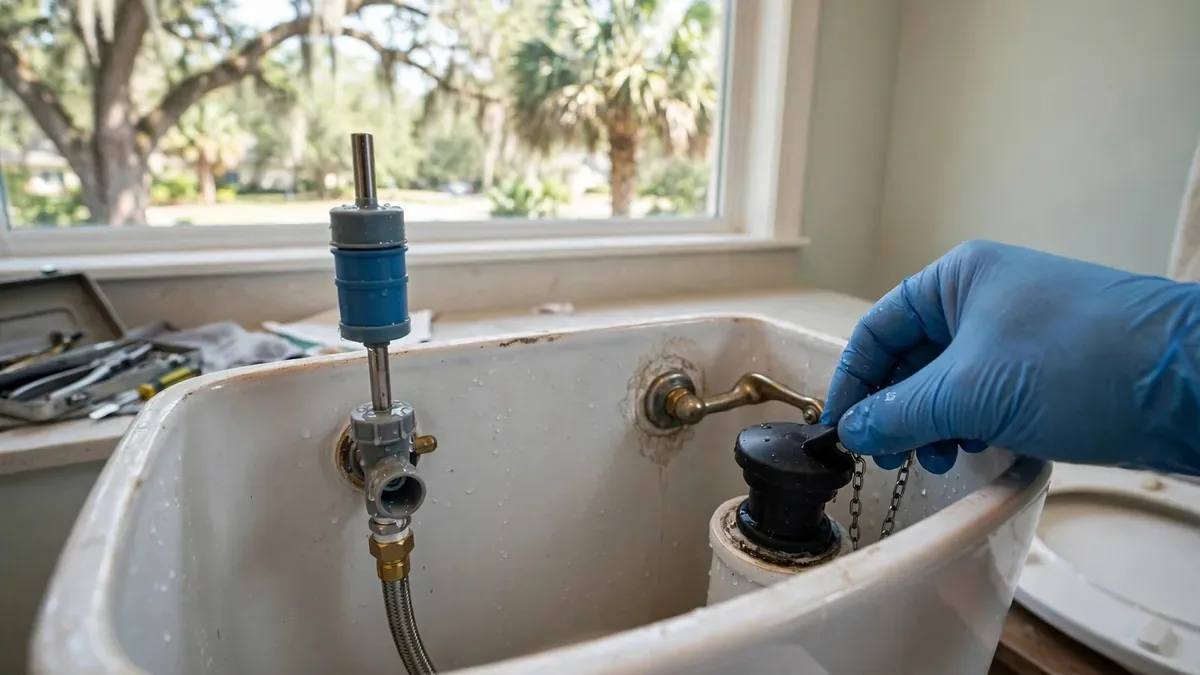
A toilet flapper is a rubber or silicone seal that sits over the flush valve opening at the bottom of the tank. Pushing the handle pulls a chain, the flapper lifts, and tank water drops into the bowl. When the tank empties, the flapper falls back and the tank refills to the fill line.
Flappers fail slowly. The rubber hardens, warps, or turns slick with a chalky film, and it stops pressing flat against the seat. You hear the toilet refill by itself every 10 to 30 minutes, or you hear a faint hiss, or you see ripples in the bowl with nobody near it.
Most flappers last several years, though water chemistry changes that a lot. A single running toilet can waste hundreds of gallons a day if the leak is large, which is why a small part is worth fixing the same week you notice it. If you want a plumber to handle the whole job, our toilet repair and installation service covers flappers, fill valves, and full replacements.
Replacing the flapper in four moves
You need a new flapper, a dry rag, and about 15 minutes. No tools are usually needed for a standard two-ear flapper.
- 1
Stop the water and empty the tank
Turn the oval handle on the supply stop (the small valve on the wall or floor behind the toilet) clockwise until it stops. Flush once and hold the handle down so the tank drains. A little water stays at the bottom, so sponge it out if you want a dry seat to work on.
- 2
Remove the old flapper
Unhook the chain from the flush lever arm. Slide the two ears of the flapper off the small pegs on each side of the overflow tube, or unclip the ring if your flapper wraps the tube. Take the old part with you to the hardware store, because the shape tells you which replacement you need.
- 3
Fit the new one and set the chain
Push the new ears onto the pegs, or slip the ring over the overflow tube. Clip the chain to the lever arm so there is about half an inch of slack, roughly two links, when the flapper is closed. The next section explains why that number matters.
- 4
Restore water and test
Open the supply stop slowly, let the tank fill, and flush three times. Watch the flapper drop fully each time. Then run the dye test below to prove it seals, because a flapper can look fine and still weep.
Finding the right flapper before you buy
Flappers are not universal, and a wrong size is the top reason a new one still leaks. The first thing to check is the flush valve opening. Look into the tank bottom. A 2-inch opening is the older, smaller standard, and a 3-inch opening is common on newer and low-flow models. Measure across the opening or look for a size printed on the old flapper.
Next, check how it attaches. Two-ear flappers hinge on pegs. Ring-style flappers fit around the overflow tube. Some toilets have a tank-to-bowl seal that is a flat disc or a canister, and those need a different part entirely. Read the model number inside the tank lid or stamped on the back of the tank.
Adjustable universal flappers fit many toilets, and a float arm that slides sets how long the flapper stays open. They are a reasonable fallback, but the manufacturer's part is usually the cleaner fit. Treat the fixture's own parts list as the authority over any package that says it fits everything.
One rule for chemicals: skip in-tank bleach tablets and blue cleaning pucks. They soften rubber and shorten the life of the new flapper, which you will notice in a year or less.
Chain slack and what each setting does
The chain is the most common cause of a flapper that is new and still leaking. Too tight holds the flapper off the seat. Too loose lets it flush weakly or tangle.
| Chain setting | What you see | Fix |
|---|---|---|
| Too tight (no slack) | Constant trickle, flapper hovers a hair above the seat | Move the clip to a higher link or shorten the chain until it has about 2 links of slack |
| About half an inch of slack | Clean flush, flapper drops flat and quiet | Leave it alone |
| Too loose (long dangle) | Weak or partial flush, chain slips under the flapper and blocks the seal | Clip a shorter link and trim the extra tail with scissors |
| Chain on wrong lever hole | Handle feels stiff or tank barely empties | Use the hole nearer the lever pivot for a lighter pull |
Re-check slack after the tank refills. The float and the chain shift slightly, and a wet chain can ride into a different position than a dry one.
Flapper replaced and the toilet still runs?
A licensed plumber can read the valve, seat, and fill assembly together and give you a clear price before work starts.
Checking the flush valve seat
The flapper seals against a ring called the flush valve seat. If the seat is rough, pitted, or crusted, even a brand new flapper will not seal. Run a fingertip around the seat once the tank is dry. It should feel smooth like a bathtub edge. If it feels gritty or ridged, that is mineral buildup.
Clean it with a nylon scrub pad or a piece of fine plastic scouring pad and a little white vinegar on a rag. Do not use steel wool, which leaves metal specks that rust, and do not use a razor, which can nick the plastic. Rinse, wipe dry, and test again.
A seat that is cracked or has a chipped lip is a different problem. Some toilets let you fit a screw-on or clip-on repair seat that restores a flat surface. Others have the seat molded into the porcelain or the tank, and the fix is a new flush valve or a tank replacement. That is when it pays to stop and call.
The dye-tablet test that settles it
A leak between tank and bowl is silent most of the time. Dye turns it into something you can see in 15 minutes.
- Drop in the dye.
Use a leak-detection tablet from the hardware store or about a dozen drops of dark food coloring in the tank. Do not flush.
- Wait 15 minutes without flushing.
Keep everyone off the toilet. If color shows in the bowl, the flapper or seat is leaking.
- Read the result.
Color in the bowl means the seal is failing. Clear bowl means the flapper holds, so a running sound comes from the fill valve or the overflow tube.
- Flush to clear the dye.
Dye can stain a cracked tank or a worn bowl glaze if left for hours, so flush when the test is done.
Why hard water crusts the seat so fast here
Manhattan Beach water is hard, and that matters inside a toilet tank. Calcium and magnesium leave a white layer on the seat each time water dries between flushes. The City's 2023 Annual Water Quality Report lists two sources with very different numbers.
Roughly 23 grains per gallon, range 331 to 452
Roughly 8 grains per gallon, range 81 to 220
Your tap gets a blend that changes by day, so the crust rate changes too. In practical terms, a flapper in a groundwater-heavy week sees much more scale on the seat than one in an imported-water week. If you clean the seat once and it is rough again in a few months, the water is the cause and the flapper is not at fault.
Rough seats shorten the life of every new flapper. A softener or a scale-reduction setup protects the whole house, and our water softener and filtration service explains the options.
When the flapper is not the problem
If a good flapper, a clean seat, and correct chain slack do not stop the noise, the cause is elsewhere. Match your symptom here.
| Symptom | Likely cause | What to do |
|---|---|---|
| Hissing while the tank is full | Fill valve not shutting off | Adjust the float height or replace the fill valve |
| Water runs down the overflow tube | Water level set too high | Lower the float so water stops about 1 inch under the tube top |
| Dye shows in the bowl | Flapper, seat, or flush valve leak | Clean the seat, or replace the flush valve if cracked |
| Toilet refills and you hear nothing | Slow leak at flapper edge | Replace the flapper again with the exact model part |
| Water on the floor near the base | Wax ring, tank bolts, or supply line | Stop using the toilet and call a plumber |
| Water bill jumped, no visible leak | Leak elsewhere in the house | Check the meter with everything off, see the note below |
A running toilet can hide a bigger issue. If the meter keeps moving with every fixture off, a leak detection visit finds hidden lines without opening walls.
Manhattan Beach note
Manhattan Beach water and your toilet tank
The City of Manhattan Beach supplies your water as a blend of pumped groundwater and treated imported surface water bought from the Metropolitan Water District. The 2023 report also lists average pH of 7.8 for groundwater and 8.5 for surface water, with a chlorine and chloramine residual averaging 1.8 mg/L.
The practical point for a flapper: chloramine and chlorine break down rubber over time, and scale builds on hard surfaces. Sand Section homes near the ocean and Hill Section homes drink from the same system, so the flapper's lifespan depends more on your fixture and habits than your street. Read the City's report for the current numbers.
Sources: City of Manhattan Beach
When to stop and call a plumber
Flapper work is a good first DIY job. Stop if the tank is cracked, if the flush valve is loose or spins when you touch it, if the shutoff does not close fully, or if water appears at the base of the toilet. Any of those turns a 15-minute fix into a seal or fixture repair.
Rental owners and multifamily managers should treat a running toilet as a small leak with a real bill attached, since nobody in the unit is watching the meter. If you manage units in nearby towns, the same crews work in Hermosa Beach and Redondo Beach, where the Cal Water groundwater reads even harder, so scale on the seat tends to come back faster.
FAQs
Toilet flapper questions from Manhattan Beach homeowners
There is no fixed schedule. Check yours once a year with the dye test and replace it when color shows in the bowl or the tank refills on its own. Hard water and chlorine tend to shorten the life.
A flapper that physically fits can still leak if the shape or weight is wrong. Match the size (2-inch or 3-inch) and attachment style, and prefer the manufacturer's part when you can read the model number.
The usual causes are a chain with no slack, a crusted or pitted seat, or the wrong size. Fix those in that order. If all three check out, the flush valve itself may be worn.
Not ideal. Dye can stain a cracked tank or worn glaze. Wait 15 minutes, read the bowl, then flush to clear it.
No. Chlorine tablets sit against the rubber and soften it. A monthly brush of the bowl and a vinegar rinse of the seat is gentler on the flapper.
It matters. The City's 2023 Annual Water Quality Report gives groundwater an average of 392 mg/L hardness (roughly 23 grains per gallon) and imported surface water 136 mg/L. Scale from the harder blend builds on the seat, so a flapper can leak from a rough seat even when the rubber is new.