
Start here
A leaking toilet usually comes from one of four places
Leaking toilet repair begins with finding the exact point where water escapes. A toilet has a supply line that feeds the tank, a fill valve inside the tank, tank bolts that hold the tank to the bowl, and a wax ring that seals the base to the drain. Each fails in its own way and each looks different on the floor.
Guessing wastes a weekend. Replacing a wax ring when the real culprit is a sweating tank means pulling a 60-pound fixture for nothing. The fastest approach is to dry everything with a towel, lay down dry toilet paper around the base and along the wall, and wait ten minutes. Wet paper shows you where the drip lands.
If you would rather have a licensed plumber read the signs, our toilet repair crew handles supply lines, tank kits, and reset jobs, and gives a clear price before work starts.
Toilet connections, flange and supply fittings are covered by the California Plumbing Code, based on the Uniform Plumbing Code (UPC), which is why a lasting fix uses listed parts.
Decision table: match what you see to the likely cause
Use the first column as your symptom and read across. If two rows fit, check the cheaper fix first.
| What you see | Likely source | DIY or call |
|---|---|---|
| Drip or puddle at the wall valve or the line to the tank | Supply line or supply stop packing | DIY: tighten a quarter turn or swap the braided line. Call if the stop valve will not close |
| Water under the tank where it meets the bowl | Tank bolt washers or the tank-to-bowl gasket | DIY with care: replace the bolts and rubber washers. Porcelain cracks if over-tightened |
| Water at the base, worse after flushing | Wax ring failure or loose closet bolts | Call: the toilet must be pulled and reset with a new ring |
| Whole tank wet on the outside, drips from the bottom | Condensation, not a leak | DIY: wipe, insulate, or check the tank liner. Ask a plumber about a mixing valve if it is constant |
| Tank keeps running, bowl ripples | Flapper or fill valve | DIY: replace the flapper or the fill valve |
| Water drips from the overflow tube top | Float set too high | DIY: lower the float |
| Ceiling stain below an upstairs bathroom | Base seal, drain joint, or shower | Call: shut off water to the toilet and stop using it |
A soft or spongy floor next to the toilet changes the call. That is a subfloor problem, not a nuisance leak.
The four leak points in detail
Each of these has its own tells.
Supply line and shutoff
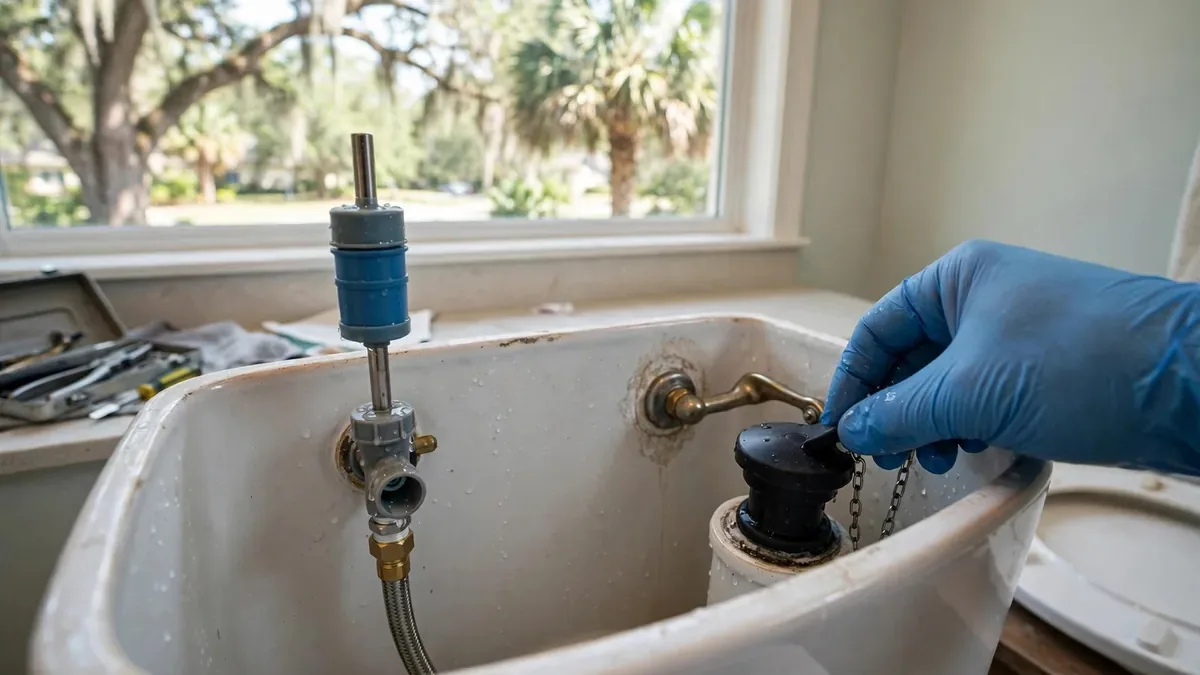
The braided or plastic line between the wall stop and the tank bottom has a nut at each end. A drip at either nut often stops with a quarter turn by hand or wrench. If the braid is frayed or the nut is corroded, replace the line. Do it with the stop closed and the tank drained, and keep a towel handy for the last cup of water.
Tank bolts and gasket
Two bolts through the tank bottom hold it to the bowl, and a rubber washer under each bolt head keeps the seam dry. When the washers harden, water seeps down the bolt and drips from the base of the tank. New brass bolts and washers cost little. Tighten evenly and stop when snug.
Wax ring and base
A wax ring or foam gasket seals the toilet outlet to the drain flange in the floor. A failed ring leaks only when you flush, so the puddle appears at the base minutes later. You might also smell sewer gas. This needs a toilet pull. Do not caulk around the base to hide it, because that traps the water under the toilet.
Fill valve and float
A worn fill valve can spray or overflow into the overflow tube. A cracked fill valve shank leaks onto the floor each time the tank refills. Replacement kits are inexpensive and install without soldering. Match the height of the old valve so the float clears the lid.
Water at the base is easy to mistake for a tank sweat. Check the supply line first, then tank bolts, then the base.
Run the meter check before you open anything
A toilet can leak into the bowl for months with no visible puddle. The water meter shows if you are losing water somewhere.
- 1
Turn everything off
Close taps, stop the dishwasher and washer, and pause any irrigation. Nobody flushes during the test.
- 2
Read the dial
Find the meter box, usually near the curb or the property line. Lift the lid and look at the small leak indicator, a triangle or small wheel that spins when any water moves. Photograph the dial.
- 3
Wait 30 minutes
Do not use water. Read it again.
- 4
Compare and isolate
If the indicator spun or the reading rose, close the supply stop at the toilet and repeat. If the meter now stays still, the toilet is the leak. If it keeps moving, the leak is elsewhere and a leak detection visit with acoustic and thermal tools can find it without opening walls.
Floor soft or wet near the toilet?
Shut the supply stop first, then call a plumber who can pull and reset the fixture the same day when appointments are open.
When a toilet leak becomes subfloor damage
Small leaks do real harm over time. Water that seeps under a toilet soaks the wood subfloor, and a few weeks of regular wetting can soften it. Past that point, mold and rot spread under the vinyl or tile where you cannot see them. Spots that darken, floors that flex, and rocking toilets are warning signs.
A leak above living space, such as a second-floor bathroom, can stain the ceiling below and spread into drywall. Any bathroom stacked over a finished room, in a house or a condo, carries this risk, so act quickly when you see a ceiling mark.
What to do right now
- Close the supply stop behind the toilet by turning it clockwise until it stops.
- Flush once to empty the tank and bowl, then put towels around the base.
- Stop using that toilet and take photos of the damage for your records.
- Call a plumber if the floor feels soft, if the toilet rocks, or if water stains the ceiling below.
What a licensed plumber does that a quick fix cannot
A pull-and-reset starts with a dry tank, then removal of the toilet, a new wax ring or gasket, and a check of the closet flange for cracks or low height. If the flange is damaged, a repair ring or flange replacement comes next. Moving a toilet to a new spot is a different job, covered under our plumbing installation work.
A plumber also checks the closet bolts, levels the toilet, and runs a flush test that watches the base for a full minute afterward. Trust that test more than a dry-looking floor, because a slow wick can hide for a day or two.
Manhattan Beach note
Why Manhattan Beach toilets and water lines wear faster
The City's 2023 Annual Water Quality Report gives groundwater an average total hardness of 392 mg/L (roughly 23 grains per gallon) and imported surface water 136 mg/L. Hard water crusts the stop valve stems and the nuts on supply lines, which makes them seize and drip when you try to loosen them.
That is why a supply stop that has not been turned in years may leak the moment you touch it. If a stop will not close fully, do not force it. Call a plumber, because replacing a stop valve is simpler than repairing a broken pipe after a stripped fitting.
Rentals, condos, and what to tell your owner
If you rent or live in a condo, report any leak the day you see it. Many leases and HOA rules require prompt notice, and a slow toilet leak can damage the unit below. Photograph the area, note the date, and keep the towels you used.
Owners of small multifamily buildings in the beach cities should add toilet bases to their yearly inspection. Crews also work in Hermosa Beach and Redondo Beach, where the same checks apply to any building with bathrooms stacked over other units.
FAQs
Leaking toilet questions
Dry everything, then put dry tissue around the base and under the tank bolts. Flush once. Tissue that wets at the base points to the wax ring. Tissue wet under the tank points to the bolts or the tank gasket.
Some homeowners do. It means shutting the water, draining, disconnecting, lifting a heavy fixture, scraping the old wax, and reseating on a new ring. Mistakes mean sewer gas and a second leak, so many people call.
Maybe not. Cold water in a warm room makes a tank sweat. If the dripping stops when the room cools or the tank is dry underneath, it is condensation. Constant wetness points to a crack or a bad gasket.
There is no safe interval. Wet wood can start to soften in weeks, and hidden damage is possible even sooner when a leak is constant. Treat any steady water on the floor as urgent.
Policies often cover sudden damage but not slow leaks or wear. Ask your insurer about your coverage before work starts.
A toilet leak that stays in the building is yours to fix. If the problem is a blockage in the line, the lateral from the home to the main is the property owner's responsibility (Manhattan Beach Municipal Code 5.36.240), and the City asks for 24 to 48 hours notice before you flush or clean it. City Utilities is at (310) 802-5304 on weekdays.