
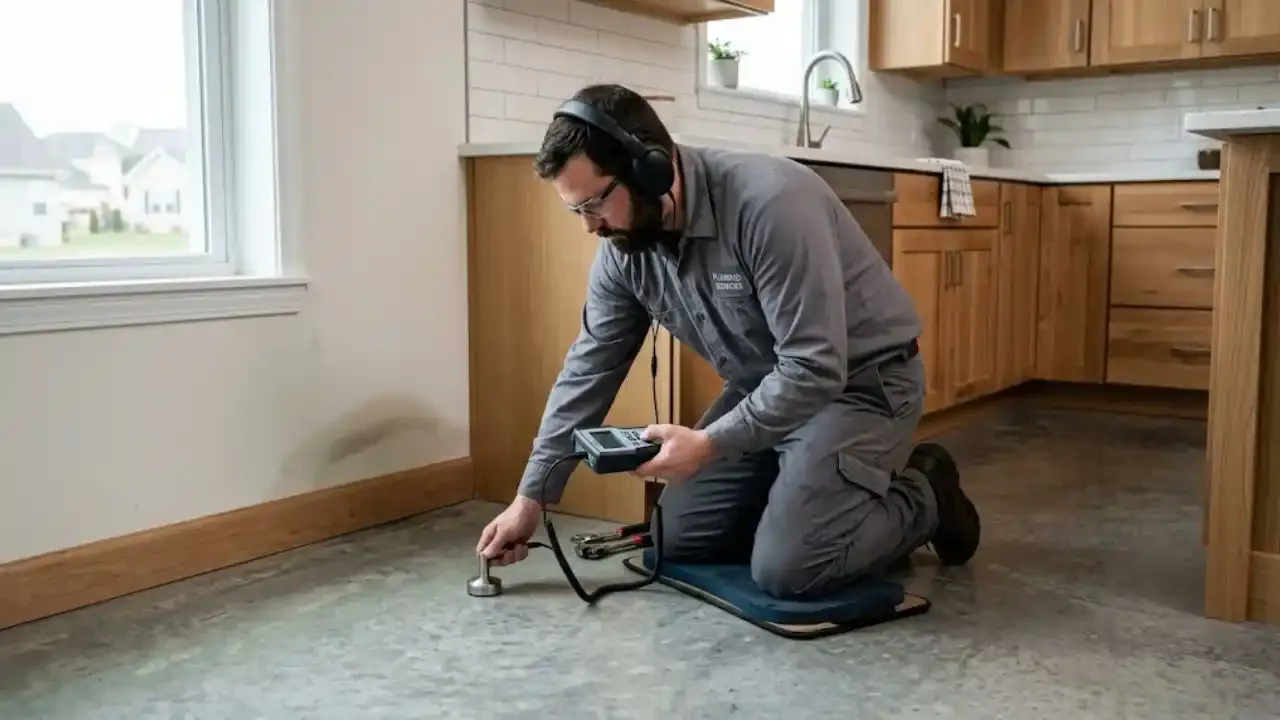
What a slab leak repair expert should actually do
A slab leak repair expert is a licensed plumber who can locate a pressurized water line leaking under or in a concrete floor, explain the repair options and complete the work with a written scope. The word expert is not a license class, so you judge it by method and paperwork.
The most important question is how they find the leak. If the answer is a guess, a hunch or a quick jackhammer, keep looking. If the answer names equipment and a test, you are closer.
Everything after that follows from the locate. A good specialist will not quote a repair until the leak is isolated.
Whatever repair method you choose, the finished work has to meet the California Plumbing Code, which is based on the Uniform Plumbing Code (UPC).
Detection methods to ask about
A specialist should be able to describe more than one tool and say why they use it.
- Acoustic ground microphone.
A sensitive listening device is moved across the floor to pinpoint the loudest hiss or rush of water in the pipe.
- Thermal camera.
Hot water line leaks can show as warm patches. It works best on hot lines and is a screening tool, not proof.
- Isolated pressure test.
Sections of the supply are closed off and monitored to see which one loses pressure. This narrows the leak to a line before anyone cuts.
- Electronic line tracing.
A tone sent through a metal pipe lets the tech follow its path under the slab so the opening is placed over the pipe, not beside it.
- Meter test and shutoff walk.
Closing the main and watching the meter confirms whether the leak is on the house side.
Spot repair, reroute or repipe: how to decide
Once the leak is located, you have three real choices. Here is how they differ.
| Option | What happens | Good when | Trade-offs |
|---|---|---|---|
| Spot repair | Open the slab over the leak, replace the section, patch concrete | One isolated failure, accessible location, line otherwise sound | Floor finish disturbed, other sections may fail later |
| Reroute | Abandon the leaking line and run new pipe through walls or attic | Repeated leaks in one line, or hard-to-reach location | Walls or ceilings opened and patched, new route to plan |
| Repipe | Replace most or all of the supply lines | Multiple failures, aging or problem pipe, ongoing pinholes | Higher up-front work, whole-house disruption, longer timeline |
Ask the specialist which option they would choose and why. A good answer refers to your pipe material, the number of failures and your floor layout, not just to what they prefer to sell.
Want a second look at a slab leak diagnosis?
Bring the report and we will tell you what we would check next.
Verify the license and the deposit before you sign
A few minutes on the state site protects you more than any review.
- 1
Look up the license
California requires a contractor license for projects of $1,000 or more in labor and materials. Search the license number on the Contractors State License Board website at cslb.ca.gov or call 800-321-CSLB (2752).
- 2
Match the name and status
The business name, license status and bond should match the paperwork. Ask for the number in writing and do not accept a number that does not resolve.
- 3
Check the deposit
CSLB advises paying no more than 10 percent down or $1,000, whichever is less. The exception is a contractor with a blanket bond on file. A demand for most of the job up front is a reason to step back.
- 4
Keep the contract and the locate report
File both with photos and dates. They matter for insurance and for any later warranty claim.
Red flags when you are choosing a specialist
These patterns show up when pressure replaces process.
Quote before a locate
Any price given before the leak is found and isolated is a guess. Expect a range at best.
Only one option offered
Be wary when every answer is a full repipe or every answer is a slab break. Ask for the other options and why they were ruled out.
Vague license or no number
If the license number is missing or does not resolve, stop. Never accept a verbal claim.
Large cash deposit
Compare the request to the CSLB limit, and ask for a payment schedule tied to milestones.
What a good written quote itemizes
The quote should read like a plan. It names the locating method and its result, the exact section being repaired, rerouted or replaced, the pipe material, and the access points that will be opened. It states what happens to flooring, baseboards and paint, and who handles each.
It should also list permit handling, since rules vary. Ask the Manhattan Beach Community Development or building department what applies to your job and who files. The quote should name the payment schedule, the start date range, the warranty on labor and materials and any exclusions such as flooring replacement.
If your pipe needs a bigger conversation, our slab leak repair visits start with locating before any opening of the slab, and repiping is quoted separately when findings call for it.
Manhattan Beach note
Slab leaks, soil and lots in Manhattan Beach
Manhattan Beach runs from the Sand Section near The Strand up to the Hill Section, where lots are steep. On a hillside lot, a leak can run along the slope and surface far from the source. On a flat lot, a leak may never show on the surface, so a rising bill may be the only sign.
If water is running and you cannot reach the leak, close the main shutoff before you do anything else. The City supplies your water, so for questions about the meter or billing the City Utilities office is at (310) 802-5304, Monday to Friday, 8:00 to 4:30. The CSLB site is the primary source for license and deposit rules.
Sources: Contractors State License Board
After the repair: what to ask
Ask for a pressure test result after the work and a photo record of what was replaced. Request the warranty in writing and keep it with your bill history. Monitor the meter for a week to confirm the leak is gone.
If you are in a neighboring city, our crews also work in Hermosa Beach and El Segundo, and can advise on who to ask about permits there.
FAQs
Slab leak specialist questions
Common signs include a warm spot on a floor, the sound of running water with fixtures off, a meter that moves when everything is shut, and damp flooring or baseboards. A professional confirms with listening equipment and an isolated pressure test, because several of those signs overlap with other leaks.
Not automatically. A single failure may be a spot repair. Repeated failures in one line may justify rerouting that line. Many failures across the house, or pipe known to fail in groups, can justify repiping. The right answer depends on findings, not on a sales target.
Spot repair usually means opening the slab over the leak after it is located. Rerouting runs a new line through walls or attic and avoids the slab. Ask the specialist which approach fits your layout and what finishes are affected.
Locating method and result, the repair approach, how floors and finishes will be restored, who handles permits if required, materials, the warranty terms and the total, with payment schedule. Ask for the quote to itemize each of these.
Policies often cover sudden accidental water damage but may not cover the pipe itself or the cost of reaching it. Ask your insurer before work starts and keep the locate report and photos.
Water from a leak does not always surface where the pipe fails. On steep Hill Section lots it can travel along the slope, and on flat Sand Section lots it may never show at all. Either way, ask the specialist how they confirm location before cutting, not after.