
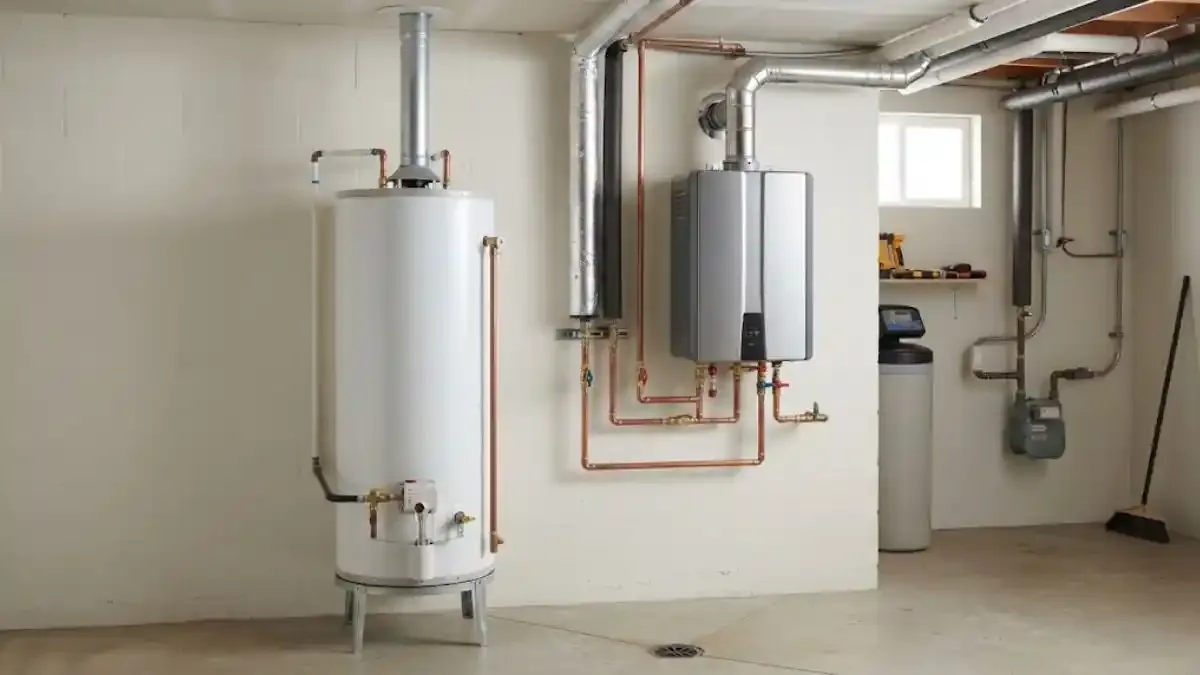
Why a 40 gallon tank has no direct tankless equivalent
A tankless water heater sized to replace a 40 gallon tank does not exist as a one-to-one swap, because a tank is rated by storage volume and a tankless unit is rated by how much water it can heat per minute. The measure that matters is gallons per minute (gpm) at a given temperature rise, which is the number of degrees the unit adds to the incoming water.
A 40 gallon tank gives you a burst of stored hot water, about 30 to 35 gallons usable before it runs cold, then a slow recovery. A tankless unit gives you a steady flow with no limit on duration, but a ceiling on how many fixtures can run together. The two behave differently, so we size from your fixtures instead of from the old tank.
Two numbers drive everything: the flow you need at peak, and the temperature rise you need on your coldest days.
Sizing is only half of the job, because the California Plumbing Code, based on the Uniform Plumbing Code (UPC), and the manufacturer's instructions also govern gas, venting and water connections.
The sizing method in four moves
This is the calculation we use, in the order we use it.
- 1
List what runs at the same time
Think about your busiest morning. A shower and a kitchen faucet at once, or a shower and a dishwasher. Count only fixtures that can overlap, not every fixture in the house.
- 2
Add the flow of each fixture
Use the fixture's rated flow. Showerheads are commonly 1.5 to 2.5 gpm, kitchen faucets about 1.5 gpm, bathroom faucets about 1.0 gpm, dishwashers about 1.5 gpm and clothes washers about 2 gpm. Check your own fixtures for the real figure.
- 3
Work out the temperature rise
Subtract incoming cold water temperature from the temperature you want. Aiming at 120 degrees and starting from 60 means a 60 degree rise. Cooler months raise the figure, and a unit that performs well in summer can lag in winter.
- 4
Match the unit's gpm curve
Every unit publishes a gpm rating at a given rise, and the number falls as the rise goes up. Pick a unit whose rating at your rise meets or beats your peak flow.
Worked example: a four person household
Say a household of four has two showers and a kitchen. They run the shower and the dishwasher at the same time most mornings, and sometimes a second shower.
| Scenario | Fixtures running together | Flow (gpm) | Rise needed at 120 F from 60 F | Practical read |
|---|---|---|---|---|
| Typical morning | One shower (2.0) and dishwasher (1.5) | 3.5 | 60 degrees | A mid-size unit with about 4 gpm at that rise will cope |
| Busy morning | Two showers (2.0 each) and a bathroom faucet (1.0) | 5.0 | 60 degrees | Needs a larger unit, around 5 or more gpm at that rise |
| Busy morning plus laundry | Two showers, faucet and washer (2.0) | 7.0 | 60 degrees | Few units reach that at this rise, so consider two units or staggering use |
| Winter morning, one shower | One shower (2.0) | 2.0 | Possibly 70 or more | Any unit handles it if rated for the rise |
The point of the table is the pattern. Flow adds up quickly, and each added fixture costs gpm. The cure for an undersized unit is rarely a bigger tank-style compromise, it is either a larger unit, a second unit, or a change in habits.
Want your own numbers worked out?
Tell us how many bathrooms and what runs at once, and we will do the math with you.
Gas versus electric, stated generally
Fuel type changes size limits more than most people expect.
| Factor | Gas tankless | Electric tankless |
|---|---|---|
| Typical output | Higher gpm at a large rise | Lower gpm, fewer fixtures at once |
| Installation needs | Gas line capacity and venting | Large electrical load, often multiple dedicated breakers and heavy wiring |
| Where it shines | Whole-house demand | Point of use or small homes, or where gas is unavailable |
| Common limit | Gas line sized for the old tank | Panel capacity |
| Energy cost | Depends on local gas rates | Depends on local electric rates |
Heat pump water heaters are a separate category with their own sizing and space needs. If you are looking at a 40 gallon heat pump swap, that is a different conversation than tankless.
What to check before you buy a tankless unit
Sizing is only half the project. A whole-house gas tankless usually asks for more gas than the tank it replaces, so the gas pipe size and meter capacity should be checked. It also needs a vent path that meets the manufacturer's clearances. The vent and gas items are the reason a tankless job costs more than a like-for-like tank swap.
Look at the water too. Hard water scales the heat exchanger and eventually cuts flow. We cover how that works in Manhattan Beach water below. Ask for isolation valves so the unit can be descaled.
Finally, check the floor plan. Tankless units hang on a wall, which can free floor space in a garage or closet, but the vent run and gas line need room too.
Manhattan Beach note
Manhattan Beach water and your tankless choice
The City's 2023 Annual Water Quality Report lists total hardness at an average 392 mg/L for local groundwater and 136 mg/L for imported surface water. That is roughly 22.9 and 8.0 grains per gallon by our conversion. Because the blend varies, a unit in Manhattan Beach should be planned for scale, and any maker's warranty terms on water quality should be read before purchase.
The practical effect on sizing is small, but the effect on upkeep is real. Scale narrows the exchanger passages and reduces the flow you actually get, so a unit sized to the limit can feel undersized after a hard-water year. Leaving some margin above your peak flow, and putting a softener or scale inhibitor ahead of the unit, are the usual remedies.
Sources: City of Manhattan Beach, Annual Water Quality Report
Where to go from here
If you want a quote built from your actual fixtures, our tankless water heater service covers measuring, sizing and installation. If a tank makes more sense, water heater replacement covers the like-for-like route, including bracing and an expansion tank where needed.
We also work in Redondo Beach and El Segundo. Redondo Beach water comes from a different supplier than Manhattan Beach, so hardness numbers there are not the same. Permit rules vary, so ask the building department in your city before you order a unit.
FAQs
Sizing questions answered
It depends on peak overlap. Two showers and a faucet is about 5 gpm, while one shower and a dishwasher is about 3.5 gpm. Work from your own fixtures and your temperature rise.
It is the number of degrees the heater has to add. If your water comes in at 60 and you want 120, the rise is 60 degrees.
Not always. Bigger units need more gas or power and cost more up front. Choose the size that covers your peak flow with a modest margin.
Often yes, if the unit's gpm at your temperature rise is above the combined flow of both showers. Low-flow showerheads help.
Maybe not. Whole-house units can draw several times the BTU of a 40 gallon tank, so we check pipe size, run length and meter capacity first.
Water supply comes from the same City system across the city, so hardness is the same concern on the hill or near the beach. Where homes differ is routing. A steep lot or a long run to the vent termination can add pipe length, which is why we measure the vent path before quoting.