
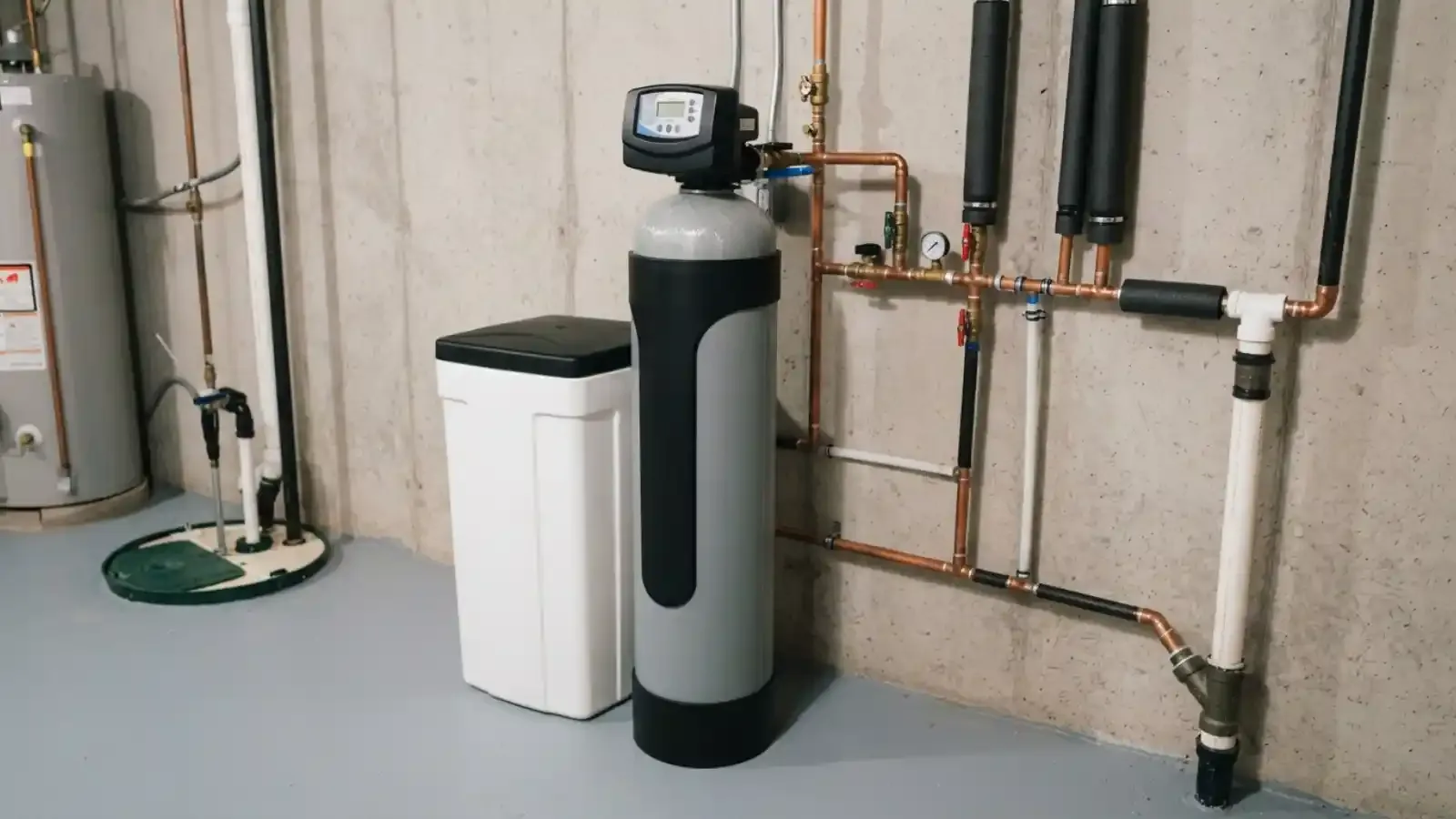
What a water filtration system costs depends on the job
A water filtration system is any equipment that treats water after it enters the building, from a pitcher-sized cartridge to a whole-home tank. Cost depends on three things: how much water is treated, what is removed, and how much upkeep you accept.
People often ask for one price. In practice there are four separate products and each has its own cost curve. Point-of-use filters treat one tap, reverse osmosis treats one tap more deeply, whole-home filters treat everything at the entry, and softeners deal with hardness only.
The cheapest approach is to treat only the water you drink. The most thorough approach treats all of it and protects the plumbing.
Point-of-use, whole-home, RO and softener compared
This table lines up what each option does so you can see where the money goes.
| Option | Treats | Removes | Upkeep | Best fit |
|---|---|---|---|---|
| Point-of-use carbon filter | One tap or pitcher | Chlorine taste, some sediment | Cartridge every few months | Better-tasting drinking water |
| Under-sink reverse osmosis | One kitchen tap | Most dissolved solids | Prefilters yearly, membrane every few years | Cooking and drinking water |
| Whole-home sediment or carbon | Every tap | Sediment, chlorine, some chemicals | Cartridge or media changes | Taste and odor at every tap |
| Salt-based softener | Hot and cold lines | Calcium and magnesium (hardness) | Salt, periodic resin care | Scale on fixtures and heaters |
| Salt-free conditioner | Whole home | Changes scale behavior, does not remove it | Media replacement | Households avoiding salt and sodium |
A filter is not a softener. If your complaint is white crust on a showerhead, carbon will not fix it. If your complaint is chlorine taste, a softener will not fix it.
Manhattan Beach hardness, from the City's own report
The City supplies water that is a blend of local groundwater and imported surface water. Its 2023 Annual Water Quality Report lists total hardness for both sources. We converted to grains per gallon at 17.1 mg/L per grain, so treat the conversions as roughly right.
Range 331 to 452 mg/L. Hard to very hard by common scales.
Range 81 to 220 mg/L. Moderately hard.
Because the blend changes, your tap may sit anywhere between those averages. A softener sized for the groundwater end handles the worst day. One sized for the surface end may run short.
Cost drivers that change the total
Ask for these items by name when you collect quotes.
- Capacity and flow rate.
A softener is sized by grains of capacity and by peak flow in gpm. Bathrooms, family size and hardness all push capacity up.
- Location and plumbing changes.
Where the unit goes, whether a drain and power outlet are nearby, and whether the main line needs new valves or a bypass all affect labor.
- Pressure and protection.
Some houses need a PRV check or a pressure gauge first, since high pressure shortens the life of tanks and fittings.
- Drain connection and brine disposal.
A softener needs an air gap to a drain. A beach lot with limited utility room space can mean a tighter install.
- Brand, media and warranty terms.
Resin quality, valve design and electronics vary. Ask what the warranty covers and who services it.
Unsure which system fits your water?
We can walk through your complaints and recommend the smallest fix.
Ongoing costs most buyers forget
The sticker price is only part of ownership. These recurring items add up.
| System | Recurring item | How often | Notes |
|---|---|---|---|
| Under-sink RO | Prefilters and membrane | Prefilters about yearly, membrane every few years | Follow the manufacturer's schedule |
| Salt softener | Salt and water for regeneration | Salt every few weeks | Water use rises slightly on regeneration |
| Whole-home filter | Cartridges or media | Varies with water quality | Sediment loads shorten life |
| Point-of-use filter | Cartridges | Every few months | Skipping changes can add bacteria |
For rough planning only, an under-sink filter or RO unit often runs from a couple hundred to several hundred dollars installed, and a whole-home softener setup commonly runs well into the low thousands. These are widely quoted ranges and not our prices. Ask for the quote to itemize equipment, labor and the first fill of salt or media, then call for your real number.
Manhattan Beach note
What the City's 2023 water report says about your tap
The City of Manhattan Beach reported that its tap water met all EPA and state primary drinking water standards in the 2023 Annual Water Quality Report. It also reported lead at the tap with a 90th percentile of 4.4 micrograms per liter across 33 samples in 2022, and copper with a 90th percentile of 0.29 mg/L.
The report says both lead and copper come mainly from corrosion of household plumbing, and that the City cannot control plumbing materials inside your home. For that reason it advises flushing the tap for 30 seconds to 2 minutes when water has sat for several hours. The same report notes a disinfectant residual of 1.8 mg/L average as chlorine/chloramine, which is what carbon filters mainly target.
If you are in Hermosa Beach or Redondo Beach, check which system serves your address, since Cal Water's Hermosa-Redondo district publishes its own report.
Test your tap before you buy
Equipment should match a measurement, not a sales pitch.
- 1
Read the City's annual report
It lists hardness, pH, disinfectant and the lead and copper results for the whole system.
- 2
Test at your own faucet
Hardness strips are cheap, but a lab test for lead and copper at your tap tells you about your house plumbing. Test first-draw and after flushing.
- 3
Match the complaint to the equipment
Taste goes to carbon or RO. Scale goes to a softener. Lead worries go to a certified filter, plus flushing.
- 4
Get an itemized quote
Compare equipment, install labor, permits if applicable and first fill. Our water softener and filtration work follows that order, and a repiping conversation is separate if the pipes themselves are the source.
Neighboring towns and what to ask
Hardness and chemistry change by system. Our crews also work in Redondo Beach and Hermosa Beach, where Cal Water's 2023 report listed groundwater hardness of 560 ppm, a level it calls very hard. Imported water in those districts ranged from 81 to 153 ppm.
For any address outside Manhattan Beach, ask your water provider for its annual report before sizing equipment. That one document saves guesswork.
FAQs
Water filtration cost questions
A softener removes hardness minerals through ion exchange and protects pipes and heaters from scale. A filter removes chlorine taste, sediment or specific contaminants depending on media. Many homes want a softener for scale and a small drinking-water filter at one tap.
Only a filter certified for lead reduction does, and it must be maintained on schedule. Lead and copper at the tap come mainly from household plumbing, so also flush the tap before drinking if water has sat for hours.
RO is a strong point-of-use choice for drinking and cooking water because it removes dissolved solids. It wastes some water, needs a tank and a drain connection, and has filters and a membrane to replace.
Typically every few weeks, depending on tank size, hardness and household water use. Keep the brine tank at least a quarter full and check it monthly.
Softened water adds a small amount of sodium. Some households plumb a separate unsoftened drinking tap or add an RO unit. Ask your doctor if you are on a sodium-restricted diet.
Because the City blends locally pumped groundwater, which averaged 392 mg/L as CaCO3 hardness in its 2023 report, with imported water that averaged 136 mg/L. The mix at your tap depends on the day, so a single test can land anywhere in between. Test more than once before sizing a softener.