
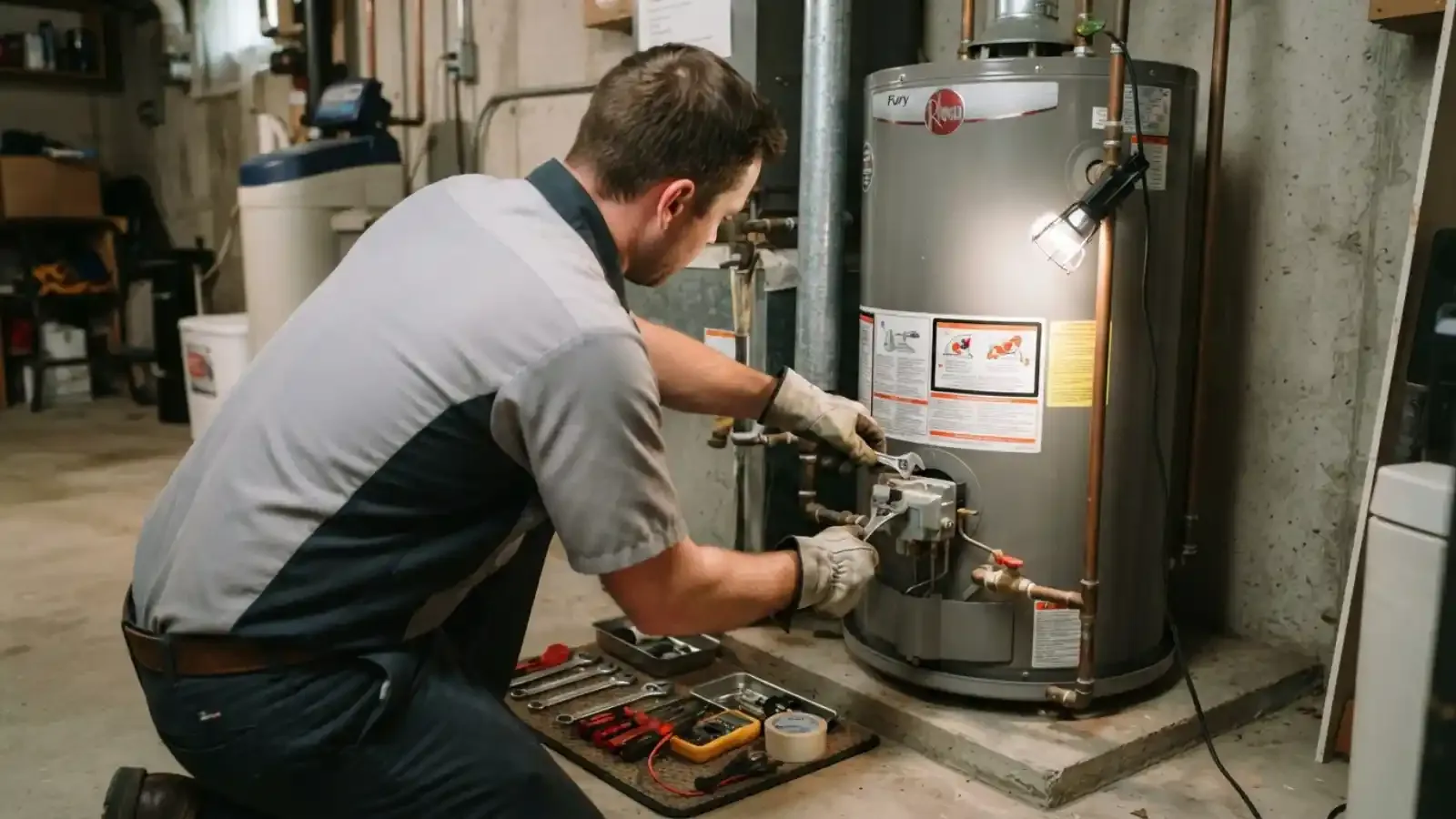
What an anode rod does inside your water heater
A water heater anode rod is a long metal rod, usually 3/4 inch thick and screwed into the top of the tank, that rusts away so the steel tank does not. It is a sacrificial part. Water, heat and dissolved minerals attack whatever metal they can reach, and the rod is made of a metal that gives up electrons more easily than the steel lining of the tank. The rod takes the damage first.
Most residential tanks hold 40 or 50 gallons and carry a glass lining over the steel. That lining always has tiny flaws. At each flaw the bare steel is exposed to hot water, and the anode rod protects those spots. When the rod is gone, the flaws start to rust, and a rusted pinhole in a pressurized tank means a leak that no wrench can fix.
That is why the rod gets so much attention from plumbers. It costs far less than a heater, it is often reachable from the top of the tank, and it can add years to a heater that is otherwise healthy. It cannot rescue a tank that has already rusted through, which we cover below.
Signs the anode rod is spent
The rod hides inside the tank, so you read it from symptoms and from a direct look. These are the signs we check first.
- Rotten egg smell from hot water only.
Sulfate reducing bacteria feed on the hydrogen gas a magnesium rod produces. Smell on the hot side alone points at the tank. A worn rod, or the wrong rod, is a common cause.
- Popping, rumbling or knocking when it heats.
Sediment that settles at the bottom traps steam bubbles under it. This noise is mostly a sediment problem, but a heater with a dead rod and heavy sediment usually has both.
- Rusty or brown hot water.
If cold water runs clear and only hot is tinted, the inside of the tank is shedding rust. The rod has likely been gone for a while.
- A bare, thin core wire.
When the rod is pulled, a healthy one is still thick with only light pitting. A spent magnesium rod is pencil thin or bare steel wire with chunks missing. Under about 1/2 inch of coating left on most of its length, replace it.
- Rod older than three to five years.
Hard water eats rods faster. In a hard water area, a yearly look is cheap insurance, especially on tanks that are already past their sixth year.
Magnesium, aluminum or powered: which rod fits
Rod choice depends on your water and your complaints. This table is the short version of how we decide.
| Rod type | Best for | Trade-off | Typical lifespan |
|---|---|---|---|
| Magnesium | Softer water, standard use, tanks under warranty | Corrodes fastest, can feed sulfur smell | About 3 to 5 years, less in hard water |
| Aluminum (often with zinc) | Hard water, longer service | Dissolved aluminum in the water, which some households avoid | Often 4 to 6 years or more |
| Aluminum and zinc | Smell control in water that grows sulfur bacteria | Zinc helps reduce the smell, same aluminum caveat | Similar to aluminum |
| Powered (impressed current) | Persistent smell, tough water, long-term tanks | Higher part cost, needs an electrical outlet nearby | Electrode is not consumed the same way, and the controller needs periodic checking |
Check your heater manual or warranty first. Some manufacturers specify a rod type or expect one to be installed in a particular way, and swapping to a different metal is a decision to make with the paperwork in hand.
Why hard water and chloramine shorten a tank's life
Two things in your water set the pace for the rod. The first is hardness. Hot water at 120 to 140 degrees drives calcium and magnesium out of solution, and they settle as scale on the heating element or the tank floor. A scale blanket makes the burner or element work harder and traps heat against the steel. Sediment on the floor also holds moisture against the lining.
The second is the disinfectant. Many Southern California suppliers use chloramine (chlorine plus ammonia) because it lasts longer in the pipes than free chlorine. Chloramine is more stable than chlorine, so it stays active in hot water, and it is often cited as one reason rubber parts and rods in tank heaters wear sooner. Treat that as a general trade observation and not a precise measure for any one address.
In practice, a rod in a hard water home gets consumed faster, scale builds faster, and the tank tends to age faster than the same model in a soft water area. Inspect more often, flush the tank, and decide on a rod type that matches the water.
Manhattan Beach note
What the City's water means for your Manhattan Beach tank
The City's 2023 Annual Water Quality Report says Manhattan Beach water is a blend of locally pumped groundwater and treated imported surface water bought from the Metropolitan Water District of Southern California. Total hardness averaged 392 mg/L as calcium carbonate in the groundwater (range 331 to 452), roughly 22.9 grains per gallon. The imported surface water averaged 136 mg/L (range 81 to 220), roughly 8.0 grains per gallon.
That is a wide gap, and the blend at your tap changes by day. The practical result is that your heater can see anything from moderately hard to very hard water. The same report lists the disinfectant residual as chlorine/chloramine at an average 1.8 mg/L. If you plan on a yearly rod check, a yearly tank flush and a rod type aimed at hard water, you are planning for the harder end of that range.
Anyone who wants a number specific to their street should read the City's report or ask the City Utilities office, because the report is the source for these figures.
Sources: City of Manhattan Beach, Annual Water Quality Report
How a rod replacement actually goes
A rod swap is a real plumbing job. Here is the order we follow, which also shows where a homeowner can get stuck.
- 1
Shut off the heater and the cold supply
Turn the gas control to pilot or off, or flip the breaker for an electric unit. Close the cold supply valve at the top of the tank. Open a hot tap upstairs so the tank can breathe.
- 2
Drain a few gallons and loosen the rod
Draining a few gallons through the drain valve lowers pressure and the water line below the rod. The rod head is a hex of 1 1/16 inch on most tanks, and it is usually torqued hard from the factory. An impact wrench or a long breaker bar is common, and a rod stuck for years may not move.
- 3
Pull the old rod and measure it
Overhead clearance matters. A rod up to 44 inches long cannot be pulled straight up under a low ceiling or a shelf. A flexible segmented rod solves that, and it is the usual choice in a closet or garage with a tight lid.
- 4
Install the new rod and refill
Wrap the threads with PTFE tape or pipe dope rated for potable water, seat the rod, refill the tank with a hot tap open until water runs steady, then restore power or gas. Check the fitting for drips after the first heat cycle.
Not sure what is inside your tank?
We can inspect the rod, check the tank for seepage and tell you whether a swap is worth it before you commit.
Replace the rod or replace the heater: a decision guide
The rod buys time only when the tank is still sound. Use this table to decide.
| What you see | Likely meaning | Usual move |
|---|---|---|
| Heater under about 6 to 8 years, no leaks, mild sediment | Rod is wearing, tank is healthy | Replace the rod and flush the tank |
| Heater near 10 years, rod gone, rust in hot water | Lining likely breached | Plan on a new heater, a rod may only delay it |
| Water pooling or weeping seam at the bottom | Tank has rusted through | Replace the heater, no repair exists for a leaking tank |
| Rod stuck and cannot be removed | Seized threads or corroded head | Ask a plumber, forcing it can crack the top fitting |
| Warranty still active | Manufacturer may require service records | Read the warranty first, then decide |
A new heater also gives you a chance to add an expansion tank, a drain pan, and the seismic strapping California requires. If your tank is already past its tenth year, the rod is rarely the best place to spend money.
DIY limits: where to stop and call
Many handy people can swap a rod. The risks are mostly about the parts around it. A stuck rod can twist the tank top. A gas heater has a flue and a gas control that you should not disturb. An electric heater needs the breaker off and tested dead before you touch anything near the element.
Stop if the rod will not break free with a breaker bar and sensible force, if there is water leaking at the top fitting, if you smell gas, or if the tank shows rust at the seams. Gas leaks are a safety issue, so leave the house and use the steps from SoCalGas and the CPUC.
If you are comparing the cost of a service visit against a new unit, our water heater repair team can inspect the tank and tell you which side of the line you are on. For a unit past saving, water heater replacement is the next step, and we give a clear price before work starts.
Neighbors outside Manhattan Beach
Hermosa Beach and Redondo Beach homes are served by a different water system with its own hardness figures, so the advice on rod type should be checked against that supplier's report. Our crews also work in Hermosa Beach and Redondo Beach, and the rod check, flush and inspection steps in this guide apply the same way there.
FAQs
Anode rod questions we hear
A common guide is every three to five years, and sooner in hard water. The better method is to inspect it every year or two and replace it when the core wire shows or the coating is thin.
Often yes, if the rod moves with a breaker bar and you have overhead room. Stop if it is stuck, if you smell gas, or if the tank fitting leaks. Those are the points where a plumber saves you a bigger repair.
Sometimes. The smell often comes from bacteria reacting with a magnesium rod. Switching to an aluminum and zinc rod or a powered rod can reduce it. A tank flush and a temperature check also help.
Rarely. After a decade the lining is usually compromised in places the rod can no longer protect. A new rod might delay a leak, but it cannot repair a thinned tank.
It can be. The City's 2023 report lists groundwater at an average 392 mg/L and imported water at 136 mg/L, and your tap sees a blend. Harder days mean faster rod use and more scale, so yearly checks are reasonable.
Yes. It needs a small plug-in controller and a nearby outlet, and a titanium electrode instead of a metal rod that wears away. It costs more up front but suits homes that fight smell or burn through rods.