
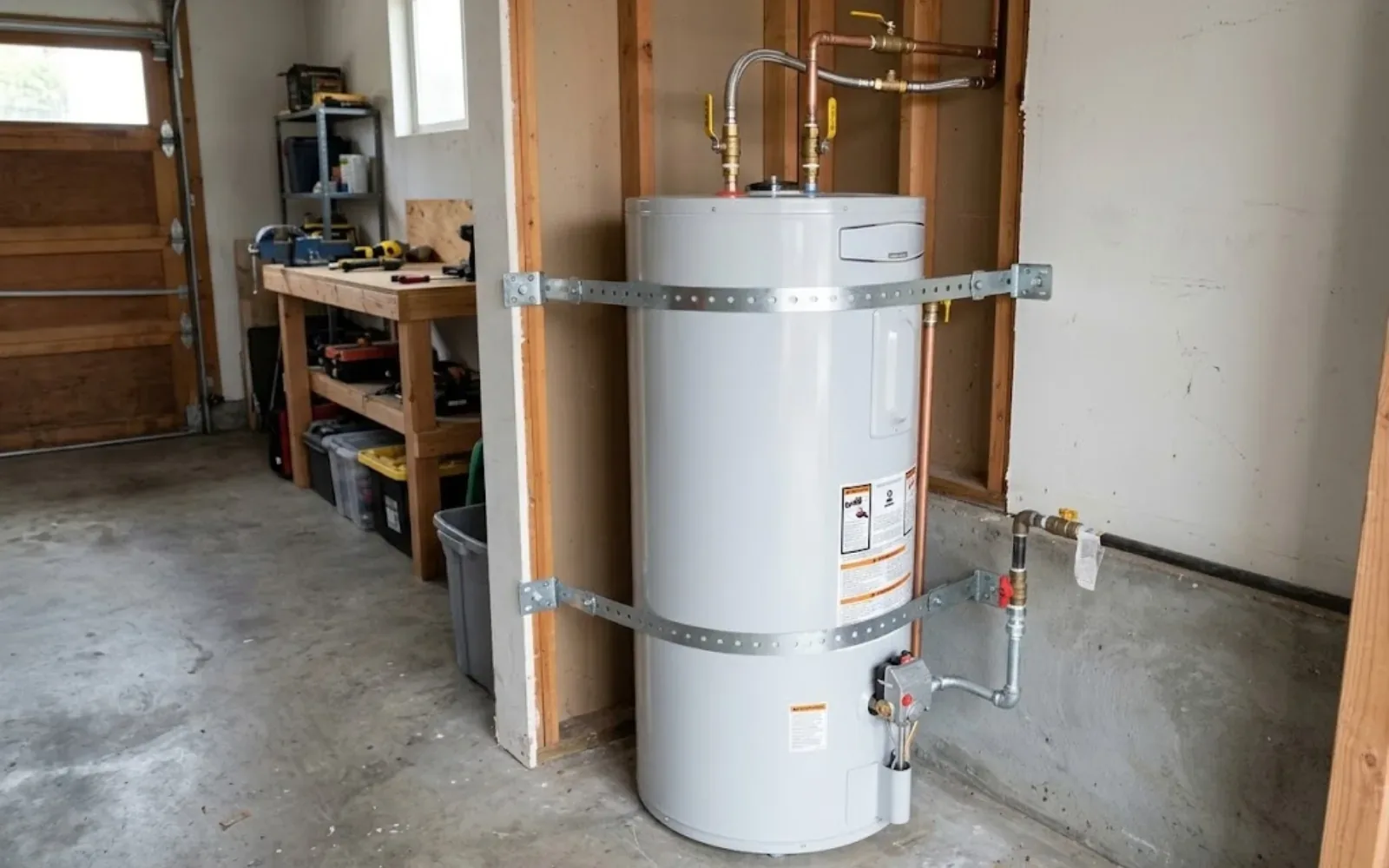
What California requires for water heater bracing
California Health and Safety Code section 19211 says all new and replacement water heaters, and all existing residential water heaters, must be braced, anchored or strapped to resist falling or horizontal displacement due to earthquake motion. The minimum standard is the California Plumbing Code, or a local modification of it. The rule applies to standard units of 120 gallons or less for which a preengineered strapping kit is readily available.
In plain terms, a typical 40 or 50 gallon tank in a garage, closet or utility room should be tied to the structure and not just standing on the floor. The requirement covers existing homes, not only new installs, which is why a heater that has sat unstrapped for years is still out of line with the law.
Strapping does not stop an earthquake from damaging a house. It reduces one specific hazard, a heavy tank toppling and tearing out the pipes that feed it.
What strapping means in practice
A proper brace is more than a loop of tape around the tank. These are the parts.
Two straps, upper and lower
Commonly the upper strap sits in the top third of the tank, and the lower strap sits about 4 inches above the controls or thermostat. Placement is set by the kit instructions and by the code, so follow those.
Anchors into framing
Straps attach with lag screws into wall studs or into masonry anchors. Drywall alone will not hold a tank. If studs do not line up, a blocking board or a bracket can bridge the gap.
Snug against the tank
The straps should hold the tank close to the wall with little slack. A strap that hangs loose will not stop a tank from swinging.
Flexible connections
Flexible water connectors and a flexible gas connector, where the code allows them, let the tank move a little without snapping a rigid pipe. Check the local rule on gas connectors with the building department.
Many kits sold for this purpose are labeled for the right tank size. Match the kit to the tank and follow its instructions.
Tank, tankless or heat pump: what each needs
Not every water heater is braced the same way.
| Type | Bracing situation | What to ask |
|---|---|---|
| Tank, 120 gallons or less | Covered by the rule, strapped to wall framing | Are straps at the right height, are anchors in studs |
| Tank, over 120 gallons | Outside the standard kit rule in the statute | Ask the building department what applies |
| Tankless, wall mounted | Fixed to the wall by its own bracket, which the maker specifies | Is the bracket set into framing as the manual says |
| Heat pump tank | Usually a tank with a larger footprint and extra weight | Bracing and clearance both need checking |
| Tank on a platform or stand | Platform must be sturdy and the tank strapped to the wall | Is the stand itself secured |
A tankless unit has no big tank to tip, but it still has gas, water and vent connections that can be stressed if the wall mount is loose. Follow the manufacturer's installation manual.
Not sure if your heater is strapped correctly?
We can look at the straps, the anchors and the connectors, and tell you what needs to change.
Check your own setup in five minutes
You can see most problems with a flashlight and a tape measure.
- Count the straps.
There should be two, one near the top and one near the bottom. One strap or none is a gap.
- Push on the tank.
Press the tank by hand. It should not rock or slide. If it moves, the anchors are loose or the straps are slack.
- Look at the anchors.
Screws should be driven into solid wood or masonry. If the strap is held by drywall anchors, that is a weak point.
- Check for rust.
Near the coast, salt air can corrode strap hardware. Flaking, pitted straps or rusty lag screws should be replaced.
- Look at the connectors.
Rigid pipes into the top of the tank can crack if the tank shifts. Flexible connectors give some play. Gas flex connectors should be looked at by a pro.
- Check the relief valve pipe.
The discharge pipe must run clear and not be capped or blocked. If strapping interferes with it, fix the layout.
Manhattan Beach note
Why strapping matters in Manhattan Beach homes
Manhattan Beach is a city of about 3.94 square miles with very different lots. The Hill Section is steep, and the Sand Section sits next to the ocean on flat walk-street blocks. A tank heater in a garage or a closet in any of those homes is a heavy object, and a toppled tank can pull on both the gas supply and the water line.
If it happens on a steep lot, where the heater may sit on a lower level or in a tight utility space, getting to a damaged valve can be harder, so knowing where your gas and water shutoffs are matters.
Near the ocean, salt air is a practical concern for the hardware. Strap steel and lag screws can rust, and a rusty strap is a weak strap. Look at them yearly. We do not make claims here about soil or fault conditions on any specific street, so ask the City or a licensed professional if you need site-specific information.
For the code text itself and for how the California Plumbing Code applies in the city, ask the Manhattan Beach Community Development / building department.
Sources: California Legislative Information, Health and Safety Code section 19211
What an inspector or insurer may look at
During a home sale, a buyer's inspector often looks at the water heater, including the straps. Some insurers and lenders also ask about bracing in underwriting or at renewal. We cannot say what any one inspector, lender or insurer will require, so the safest move is to ask them directly what they check and what proof they want.
If you are selling, ask your agent whether the water heater bracing is part of any disclosure or transfer paperwork. If you are renewing homeowners insurance, ask your agent whether bracing affects your policy. Those are questions for the professionals involved, and answers differ between companies.
When to fix it yourself and when to call
Replacing a worn strap kit on a tank that is otherwise connected properly is a fair DIY job if you can find studs, drive lag screws and read the instructions. Stop if the tank is leaking, if the connectors are rigid and corroded, if you smell gas, or if the heater is in a tight space where you cannot work safely.
Gas appliances are a particular case. A shifting tank can stress a gas connector, so do not disturb it if you are unsure. If you smell gas, leave on foot and call SoCalGas at 1-800-427-2200 or 911 from a safe distance.
Our water heater installation team adds correct bracing on new units, and water heater repair covers loose connectors and valves on existing ones. Our crews also work in Hermosa Beach and Redondo Beach, where the same state rule applies.
FAQs
Strapping questions
Yes. Health and Safety Code 19211 requires new and replacement water heaters and all existing residential water heaters to be braced, anchored or strapped against earthquake motion.
It applies to standard units of 120 gallons or less for which a preengineered strapping kit is readily available.
Commonly two, one in the upper third and one near the bottom above the controls. Follow your kit instructions and the California Plumbing Code.
It has no large tank to tip, but it must be mounted to the wall as the manufacturer instructs, and that mount should sit in framing.
They may. We cannot say what any particular one requires, so ask them what they look at and what proof they accept.
The state rule is the same. What differs is the setting. Heaters on steep lots are often in tight utility spaces or lower levels, so make sure you can reach the gas and water shutoffs and that the straps are anchored into framing. Ask the building department about any local requirement.